Showing posts with label review. Show all posts

Friday, April 26, 2013

Album Review: Love Has Come for You, Steve Martin & Edie Brickell

This review was written by request.  A friend emailed me a link to John Scalzi's blog post about the album (here) and demanded a review.  I obliged, being a fan of bluegrass and a self-proclaimed reviewer of life.  So here ya go, Bill!
------------

Steve Martin is an adept banjo player.  He's also acclaimed for several other things.  Edie Breckell is, according to Google, Paul Simon's wife, and also a folk singer that I've never heard of.  The two collaborated and released Love Has Come for You, a relatively tame but entertaining bluegrass album.  I've reviewed this like an anthology, critiquing each track.  Also, you can listen to the entire album on Youtube right now by clicking here.
When You Get to Asheville – A gentle opening track, perfect for a sunrise.  The banjo work is reminiscent of the sounds I can hear when walking through the Appalachian hills, accompanied by a voice made for country/bluegrass.  The song stays mellow and begs for a crescendo but we’re left wanting.

Get Along Stray Dog – A faster rag, almost Arabic sounding in the middle.  This is what comes to mind when thinking about Martin’s bluegrass songs, light-hearted and fun.

Love Has Come For You – Brickell’s voice really hits the twang here, gushing on love for a newborn baby that was at first unwanted.  Style is similar to the opening track.  This is the title track, which definitely sets the tone for the album up to this point.

Friend of Mine – Relatively unremarkable.

Siamese Cat – Haha.  Great opening line.  This song rises above the minimalist style that has been apparent so far, adding some “ooh-la-las” and more background music.  Still leaves me wanting to hear a more robust sound.  I do like the story this song tells.

Yes She Did – The darkest song that’s been on the album so far.  A mother, married to a drunk, throws herself in the river.  That’s pretty much it.  There’s no musing, just matter-of-fact presentation.  Kind of how a lot of old timey folk/bluegrass music does.  A short lick that’s catchy.

Sarah Jane and the Iron Mountain Baby – More upbeat and fun, with a chorus that has Martin (presumably?) lending a vocal harmony to.  I actually heard this song first on the Bluegrass Junction Sirius station.  The twang shines here, too.  Another fun song.

Fighter – I like the beat of this song, and the minor chords really add to the mood.  This is one of my favorite tracks on the record.

King of Boys – This is a bit on the ethereal side, just slightly.  Some reverb might sound pretty cool here.  The cello work in the background is a nice addition, too.

She’s Gonna Shine – An optimistic song, which is increasingly rare in the bluegrass genre.  A simple song, but nonetheless pleasant.

Who You Gonna Take? – No.  Well… the opening is annoying, but the song improves.  The music is perfectly fitting, but I just don’t like this style of talk-repetitive stuff.

Shawnee – The chorus has a line that says, “You know my creepy cousin with the handlebar moustache?  He opened up a cold one and sat down on my lap.”  Great music work and fun lyrics.  Nice beat, too.  One of my favorites on the album.

Remember Me This Way – A suitable ending to the record.  The song has a bit of finality to it.  Nothing special here.
The focus of the album is obviously Martin’s banjo work and Brickell’s vocals.  Martin plays a five-finger traditional style banjo.  His work is tight and polished and completely traditional.  Brickell sings with a powerful voice, but not explosive.  Her voice is heavy on the twang, but that’s not necessarily a bad thing.  Together the two create some great sounds.

Overall, Love Has Come for You is an easily accessible bluegrass album. It does a good job of hitting the traditional mountain music sounds, but it also does a pretty good job of telling some modern stories, too. There are a few notable highlights, but some songs that fall into obscurity, too. If you’re looking to try something different, Love Has Come for You is probably not it. But if you’re looking for some polished studio work and a solid bluegrass record, especially with a head nod to Appalachian music, look no further than this album.

-----
See also the Rolling Stone review (3-star) here.

Sunday, July 22, 2012

The Speculative Edge #1, a Review


The Speculative Edge is a brand new speculative fiction magazine with a goal set to push boundaries in the genre by publishing stories, reviews, and other assorted tidbits in a monthly digest form. Its Editor-in-Chief is Mr. Shane Collins. I've reviewed a magazine similar to this before (ResAliens #4, where I was first introduced to Collins' writing) and I enjoyed the short tales quite a bit. Needless to say, I jumped at the opportunity to review the inaugural issue of the magazine.

As explained in the "Letter from the Editor," The Speculative Edge treads familiar territory in the zine world. There are several of these types of things out there, so why add another? The answer, as Collins says, is to create a magazine that caters to the readers by blending pieces from new writers as well as established (i.e. published) authors. The magazine would also contain film and book reviews, excerpts from novels, poetry, essays, and several unique short stories. 

The majority of the magazine is devoted to fiction. For this first edition there are two interviews with established authors as well as two excerpts from their respected novels. Additionally there are four short stories, ten poems, a smattering of dated book reviews and summer film reviews, and an essay on genre and literary fiction by the Editor-in-Chief. I like to review these types of things like I review anthologies, by each individual story. I will not be reviewing the poetry or the reviews (although a review of a review could be interesting).

"The Cosmic Stringbusters," by D. L. Chance, opens the magazine's short fiction set with a sci-fi yarn infused heavily with bluegrass. Now since bluegrass runs deep in my veins (being from Western Kentucky, where bluegrass was literally born and living in the selfsame city where the International Bluegrass Museum is located) I was immediately curious about this story. On board a space vessel with a mission of spending 100 years away from earth the people are segregated into two groups: those that look back to Earth and those that look to the future. Suffice it to say that there is some tension between the two. "The Cosmic Stringdusters" is more philosophic than action-filled, but it was nevertheless a rather unique and fun story to begin with.

"Of All the Gin Joints," by C. T. Hart. This is a rather standard android/cyborg story with a slight misfire. I had questions after finishing the very short story, wondering the plausibility. Even so, when the Narrator goes into a normal bar for an evening drink and everything suddenly grows weird, I was left wondering more about the world the writer created as opposed to what just happened.

"Gravity 101," by Christian Riley. Aliens and UFOs appear. The aliens are upset and the earthlings have to pay for it. As uninspired and trite as that sounds, I actually enjoyed this piece a lot. It is another very short story, but I liked the voice of the Narrator. My imagination had fun with this story.

"They Call Her Miss Hood," by Matthew Sideman. I honestly struggled to finish this story. I'm not much of a fan of pulpy noir stuff with a whimsical self-righteous narrator, and after the first two paragraphs I groaned. The gimmick gets old very quickly. This is a story about a private investigator named Miss Hood (the Fable from "Little Red Riding Hood") and her quest to make rent by uncovering the truth from some wolves. I couldn't help but be reminded of Bill Willingham's Fables, of which I've been a fan for many years. This genre is too crowded and I did not like this story at all. Perhaps had it been shorter? Or if the writer had used a different voice?

Skipping over the poetry (Rosie of New Bedford and Asylum were my favorites) and reviews. Mr. Collins' essay, The Writing War, offers a beginners guide to literary and genre fiction. He treads no new territory, but I don't think that he was intending too, either. I've long wondered the same things he's pondered here, why we have the distinction in our books when so many of them span multiple genres. It was also nice to see Mr. Collins in support of expanding one's reading sphere and stretching out and trying new things. I've personally found that to be beneficial and enjoyable.

It's hard to say what my final feelings are concerning the first edition of The Speculative Edge. Of the short stories I enjoyed three of the four. I honestly skipped over the interviews because, well, I almost never am interested in those, regardless of the author. However I did read the two book excerpts--A Tale of Two Moons (George Wilhite) and Fallen World (C. R. Rollinger)--but neither story intrigued me enough to purchase the books. Poetry isn't something I normally read, and having no real gauge for this field I'd give it a mostly passable grade. The reviews were heavily dated, each focused on books that are a few years old. My recommendation for future editions would be to expand the fiction section, lessen the poetry section (but don't get rid of it), and have reviews for somewhat current books. The Speculative Edge is a fledgling magazine. It's not worth the print edition for a subscription, although a digital subscription isn't completely off the table. Much depends on where the magazine goes with the upcoming issues. 

If you're looking for a speculative magazine that you can get on your e-reader on the cheap (from $1.99 to $2.99 per issue), then check out The Speculative Edge, especially if you like reading stories by young and (relatively) unknown authors. Check the magazine out at their website, linked here. The first edition hits the shelves August 1.


FTC Thingy: This magazine was provided to me for free because I am ruggedly handsome and have a face made for the silver screen. Sometimes when I smile I literally break people's hearts. There were no monies exchanged between myself and The Speculative Edge, nor were there any baked goods.

Tuesday, January 24, 2012

About Google Music

I've been using Google Music since it came out of Beta, and for the most part, I've been very pleased.  Basically, it's a music streaming site that runs on cloud storage.  It was cloud storage that I wanted to try, since Stewartland1 is turning 8 years obsolete this May, and Stewartland2 is only slightly younger.  Because of this, memory is something of a problem, and I have a lot of music (around 50gigs or so).  Thus, the cloud storage.

Google Music merges with your Google account and allows the user to listen to his or her music anywhere they can sign in (as long as flash is supported).  That means that if I had a droid phone then I could listen anywhere.  That also means that I could listen at work and at home without having thousands of songs taking up hard-drive space.  This was my chief reason for signing up, well, that and my infatuation with Google's products.

I've been mostly pleased with my Google Music experience these last few months.  The player links to a Google market where you can purchase songs and albums at competitive prices, ranging from FREE to whatever.  I've not bought anything above $0.00, but what I've got from here has been good.

The only problems I've encountered have been listening at work.  My computer at work is older than Stewartland1 and the internet connection isn't as good, so I get occasional freezes.  Still, as long as I'm not doing anything too computationally intense, everything runs smoothly.  The only other issue is the randomizer used seems pretty bland, especially when listening to just one artist.

Google Music is not a streaming radio like Pandora, unfortunately, and I think this would be one area Google could improve.  Still, if you're on the go and have a droid, using Google Music seems like a smart idea.  Or, if you're like me and have limited storage space, it's a no brainer.  It does take some time to upload your music, but once it's there it's there for good.  Currently you can upload 20,000 songs for free, with pricing starting above and beyond that.

Saturday, January 07, 2012

Downton Abbey, Season 1

I'm late to the party here, but still early enough to catch the premier of Season 2 tomorrow night.  As a devout NPR listener, I'm equally devoted to PBS whenever it comes to television.  For the last several weeks, a certain commercial kept playing, showcasing a series on Masterpiece called Downton Abbey.  "This looks like something you'd like," I told Keisha, and she agreed, and that was that.  But, as it goes, it wasn't, and over the course of time, I continued to hear more and more of this show.  Capping it off was an interview on NPR's Here and Now with a critic who was lauding praises.  They played a clip, it sounded intriguing, and I decided I wanted to watch it, too.  Turns out that it was available on Netflix, and over a Friday night Saturday morning binge, Keisha and I watched the whole first season.  

Downton Abbey is an early 20th century drama, featuring an incredibly talented cast, remarkable writing, beautiful set pieces, and a perfect score.  The season begins with the sinking of the Titanic, where the heir to Downton Abbey perished, along with his family.  This left the Earl of Grantham and Lord of the estate, Robert Crawley, in a predicament, as his only children are all girls.  At the time, entailment still existed, and so the girls could not inherit.  The remainder of the season deals with finding a suitor for Mary, the eldest daughter.

Simultaneously, the audience is given insight to the running of the estate and the considerable staff required to provide for the gentry.  The ins-and-outs of the staff--a butler, a housekeeper, the Lord's valet, the Lady's maid, two footmen, three housemaids, and two kitchen staff--are the heart and soul of the show.  Every character is important to the plot, filled with a backstory, and integral to the excitement and intrigue of Downton Abbey.  Take Mr. Bates, for example.  He is arguably my favorite character, and his handicap and unwillingness to reveal much of his past propels the plot, as well as the plotting of two eager staff-people.  These two, Thomas the first footman and Misses O'Brien, are possibly the most detestable villains of any show I've watched in recent memory.

I do not intend to slight the nobles.  On the contrary, as I very much enjoy the various plots concerning the staff, I also very much enjoy the plots concerning the Crawley family.  Mary's quest for love/marriage is center here, and while I'm not much on gooey gooey stuff and lots of romance, the writers handled Mary very well.  She was a character that I both liked and dislike, and that's a good thing.  I also must give credit to the wonderful Maggie Smith a la the Dowager Countess and Robert's mother.  She is wonderfully witty and a hoot when pinned against other characters.  She provides a heavy moodiness to any situation she is in, and yet she's funny, especially when remarking on the modern technologies (swivel chairs and telephones to name two).

Honestly, I was surprised at how quickly I was caught up in the story.  Generally this kind of stuff is more up Keisha's alley.  Nevertheless, I was extremely impressed with everything about this show.  It never dipped into ridiculousness, nor did it stray too far from the many themes it makes.  Each actor is perfectly suited to their role, and each performs well above the norm.  

I look forward to starting season two tomorrow night and getting back into the affairs of Downton Abbey.  Truly, I'm eager to find out more about these people I've grown attached to and to see how much life will change in the coming years.  If you've not watched this show, I cannot recommend it enough.  It's available to watch online for free on PBS (here), as well as Netflix instant streaming.

Tuesday, November 16, 2010

ResAliens #4, a Review

Residential Aliens, a "speculative fiction [magazine] from the Seven Stars," is a bi-monthly publication that caters mostly to an electronic audience.  The niche ResAliens has is that it is a spiritually infused magazine, and its stories have a "moral or spiritual thread that appeals to the broad and varied interests of fans of speculative fiction."  (Note, this doesn't mean that the authors are Christians, as is commonly associated with the word spiritual, but the stories themselves deal with this motif.)

"Fishing the Moons of Jupiter," by Jason Rizos, tells an interesting and entertaining story on a deep-space fishing trip.  Morris, the protagonist, used to be a crab fisherman back on earth, but through various circumstances, wound up getting a job with a space crew to do some fishing work for an elusive worm.  The Hephaestus Worm has a liquid-hot, magma belly, and it is highly sought after because of its ability to produce a clean source of incredible power.  Unfortunately, the worm is also very difficult to catch.

The dialogue between Morris and his team is quick paced and realistic.  In parts, it's like watching an episode of Deadliest Catch (as mentioned in the opening note from Editor John Ottinger III), and the reader gets a great sense of how well these characters like and know each other.

Overall, this short story was intriguing enough to make me wonder about the current state of the world and how advanced it was if it is doing deep-space research now.  The worm was fascinating, and the fishing scenes were tense and enjoyable.  Plus, the ending was great.  This is an excellent quick read, and possibly my favorite from the collection.

"Overgrown," by Stoney Setzer, reads just like a standard, pulp sci-fi story.  Pink goo from outer space and a curious scientist make an unconventional, but deadly, monster.  This story was fun to read, but I found it lacking compared to the excellent first one.

"Immortals," by Leah Darrow, was frustrating to read because I so wanted to know more about what was going on.  The story never reveals why some things are, but then again, in the end, it's not important.  This was a very enjoyable read, focusing on the idea of immortality and a society where death is almost a thing of the past.

"End of Eden," by Shane Collins, is a straightforward post-apocalyptic short story that deals with two survivors trying to eke out their way to safety.  The prose was vivid and tragic, the pace quick, the science ingenious, and the overall gist a gritty ride.  I really enjoyed this piece.

"Salieri," by Marina Julia Neary, could almost be true.  It's a beautiful story with many themes going on, and in some ways it reminded me of Jonathan Strange & Mr. Norrell.  Two young pupils at the University are both at the top of their class, and their relationship is... interesting.  I think this may be my second favorite story from this collection.

"The King of Infinite Space," by Jason Reynolds, seems odd and out of place in this volume.  It was certainly my least favorite read, in part due to the almost contrived ending, surely familiar to anyone with an ear for urban legends.  Also, the speculative aspect of this story fell very flat in respect to the rest of the included stories.  Perhaps if this was in a different collection or first in the table of contents then I wouldn't have been as disappointed, but as it is, I wasn't too impressed with this, even though it was smart and well-written.

The final story, "The Testament," by Michael C. Lea, is another great one.  Through court testaments, we learn of the events that led to the death of a researcher and why her death matters (and to whom).  This piece was fascinating and kept me hooked up through the ending.  This story definitely makes the reader think, and it was a fun tale to read and discover what was going on.

Overall, ResAliens #4 is a highly enjoyable collection of spiritually sci-fi stories.  Most had me thinking about different things after I finished, and that's one thing I look for in fiction, especially short fiction.  While I want to be entertained, I also want to think, and these stories do both very well.  If you're hungry for some good, short fiction, why not try Residential Aliens?  I think it's easily worth the asking price of $2 for the digital download (click here if interested). 


*FTC thingy and a Note:  I received a general email from ResAliens #4 guest editor and acclaimed blogger John Ottinger III, of Grasping for the Wind, if I'd be interested in reviewing the current issue, and I happily agreed, intrigued by the web-zine's premise.  Thus, I paid nothing for this collection of stories.  Also, I was not asked to endorse the magazine or praise the stories, but I felt both were worthy of it.

Thursday, June 03, 2010

Avatar: The Last Airbender, Season Two

AangKitaraSokka Last fall, one of my friends let me borrow Avatar: The Last Airbender, Season One.  He thought it would be something I would like, and he was spot on.  The show is about a young boy, Aang, who is the reincarnated Avatar, master of all the elements—water, earth, fire, and air.  Aang seeks to understand his awesome power and master the elements so he can finally stop the war that has raged across the world for over a hundred years.  With help from his friends Katara and Sokka, he travels abroad, uncovering mysteries and getting into frequent trouble.

It did not take very many episodes for me to like the show.  For one, the cartoon is beautifully animated.  It’s obvious that the artists are very skilled in what they do, and watching the show is rather cinematic.  Another thing that makes the show great is how funny it is.  The ill-luck some characters have (Sokka) and the clever script has me laughing nearly every episode.  The show also juggles other emotions quite well.  Shame and guilt, longing for something more, love, all of these are infused in this cartoon, and this makes it something more than just a basic toon.  Finally, the show has an excellent plot.  While not necessarily all original, the episodes are tight and all fit together snugly, never leaving the viewer curious for too long.  Plus, it borrows from many Eastern religions and cultures (mysticism, Buddhism, Taoism, etc.), and this cross-culture type of show is both educational and perfect for setting.

I write all of this because after I finished Season One, I had no way to watch the last two seasons.  My friend only had Season One on DVD.  So, I put in a request to the local library that they get the DVDs, and finally, they have got Seasons Two and Three. 

I’ve been watching Season Two this past week or so, and I still find myself laughing and mesmerized like I did for Season One.  The depth of characters for a cartoon show is amazing, and the cast is large.  Season Two deals with Aang, Sokka, and Katara traveling to find an Earthbender to teach Aang, and after they find one, learning to Earthbend.  Along the way, Sokka discovers a clue that will help bring down the Fire Nation, something happens to Appa, and one particular character has a metamorphosis that was long in the making.  With the last episode of Season Two, “The Crossroads of Destiny,” I was excited to see how all of the characters would interact together.  By the end, I was flabbergasted and slightly angry.

I’m looking forward to checking out the concluding season from the library and seeing the rest of the drama play out.  If you’ve never watched Avatar: The Last Airbender, do yourself a favor and rent/Netflix (I guess Netflix has them.  I dunno, I don’t have Netflix, either.)  them right now.  There’s a live-action film coming out sometime based on the series, and hopefully it’ll turn out okay.  Right now I’m a bit perturbed at the casting choice, but from what I’ve seen so far, it will hold true to the show.

AvatarAirbenderBook2

Monday, December 28, 2009

Warbreaker, a review (spoiler-free)

warbreaker-sanderson It is no secret that I am a Brandon Sanderson fan. I loved his Mistborn series, and his standalone Elantris was also a thrill-ride. I may be a bit unfair towards Sanderson, but I’ve set the bar high for him and his work, and somehow he still manages to come through.

Warbreaker is an interesting and highly entertaining tale that I can easily recommend for the hardcore fantasy buff, the fledgling bird in the genre, or anyone looking for a story that’ll keep you turning the pages. Vivenna is a beautiful, proper princess that has been engaged to the God King of Hallandren since infancy. This marriage is to end the growing tensions between the small nation of Idris and the pagan lands of Hallandren. Siri, the youngest daughter of the Idris royal family, is an obstinate trouble maker, spending her time doing whatever she pleases. Soon the time comes for Vivenna to be off to T’Telir and wed the vile God King, but not everything goes as planned…

Lightsong the Bold is a Returned god of Hallandren. He spends his days idly drinking and eating, getting into verbal conundrums, and trying to convince his high priest Llarimar that he is not a god. Despite his attempts, the people still worship him, petitioning to him and offering him elaborate gifts in hope of receiving a blessing. Something happens in the Court of Gods and Lightsong becomes fascinated, searching for clues, and stumbling into something greater…

Vasher is a mysterious and powerful figure. A strong Awakener, he never lacks Breath. His black sword, Nightblood, is even more mysterious than he is. Vasher’s intentions are only known to him, but it’s clear that he’s after something grand…

The weaving of characters, ethnicity, and religion throughout this book was gracefully done and masterfully written. The religious system involving colors was unique and completely believable. Like metals were to Mistborn, colors are to Warbreaker, and I found this fascinating.

Though I really enjoyed the book, there were parts that I found tedious and eye-rolling. For the most part, I did not like the character Lightsong. His constant banter and flippant mannerisms had me bored from early on, and I wish this character would have been developed a bit differently. Sure, some of it was funny, and most of it was very clever, but I grew bored of constantly listening to him whine/speak.

In the end, Warbreaker was a great book to read and finish off the year with. By the time I reached the end, I really wanted more pages to read, and that is a good thing. While not up to par with Mistborn (few things are), it was better in some ways than Elantris and worse in others. (That is not to say that Elantris is bad by any means.) If you’re looking for a thought-provoking, entertaining fantasy novel, Brandon Sanderson’s Warbreaker is it.

Random Bits and Pieces

6 Christmases, 2 funerals
1 banjo
Star Wars Clone Wars Season One
Lost Season 5
An awesome Beatles book
2 re-mastered Beatles albums (Sgt. Peppers & Abbey Road)
Candy, clothes, and gift-cards
Lots of Star Wars stuff
Lost 1 game of chess to Todd
End of the Year Favorites tomorrow

Monday, December 21, 2009

Reviewing the new Star Trek movie

Over the weekend Keisha and I fully intended to go and watch Avatar, but things took a turn and we didn't get to go watch it. Instead we wound up renting the new Star Trek movie, directed by J.J. Abrams.

To be fair, I've never watched a single episode or movie of the Star Trek franchise. What I know about it ("Beam me up, Scotty," phasers, "Live Long and Prosper," and Klingon) all comes from being ingrained into pop-culture. Plus, as a lifetime STAR WARS fan, I just assumed Star Trek was my arch-enemy. That said, I now offer my review of the newest franchise film.

Star Trek begins with an exciting action sequence, filled with beautiful space imagery and fantastic technology. This spectacular display of future technology does not cease throughout the film, and it doesn't get old, either. The Starfleet spacecraft U.S.S. Enterprise, as well as the Romulun ship the Narada, are both visually stunning. The special effects throughout the film were all well done and only slightly cheesy a few times (a green-skinned woman? What?). Watching the fate of Vulcan was mesmerizing. Overall, I found the imagery of the movie Grade A eye candy.

The second aspect of the film I enjoyed was the intense action scenes. The few battle scenes between individuals, especially when the Starfleet crew arrived at Vulcan, were all entertaining to watch (albeit not as exciting as a lightsaber duel, but that's a different matter entirely). Abrams pumped adrenaline throughout the movie, and anyone seeking an action movie would surely enjoy this film.

For the most part the plot of the film was enjoyable, too, but not completely. To remain spoiler free there was a large problem with physics and continuity and reality that I felt would have been better explained using a different mechanism. The red-matter technology had some cool stuff to it, but the implications regarding timelines felt a bit too much. Sometimes this mechanism works (like Lost) and sometimes it doesn't (like Heroes). Besides this, the story of Kirk and Spock were both intriguing, and if you could forget about some things the conquest of the Romulans was cool, too.

In the end, Star Trek was a worthwhile movie to watch. I was entertained and thought the special effects were amazing. The story was good, but not great, due to a few fickle things I didn't like. Keisha, on the other hand, had no problems with it, so take my opinion with a grain of salt. If you're looking for a thrill-ride, sci-fi, eye-pleasing movie to watch during the Christmas season that's available on DVD, I'd recommend Star Trek.

Random Bits and Pieces
  • Nearly finished with Warbreaker. Hopefully will be before the weekend.
  • Blue Mtn. Dew is definitely not the best Dew out there.
  • Those who are dead are just living in my head.
  • I joined a gym over the weekend.
  • I joined Sams Club over the weekend.

Friday, December 04, 2009

God Gave Us Christmas, God Gave Us Love, and Treasured

GodgaveusChristmas God Gave Us Christmas, written by List T. Bergren and illustrated by David Hohn, is a children’s book describing the importance of Christmas and what it truly means. The story is simple and easy to understand and I think children would understand the meaning very easily. The major plot involves a young polar bear asking her mother questions about Santa Claus, who in turn decides to take her daughter on a trip to understand the importance of Christmas, and in turn, God.

I found this book good to listen to, as my wife read it aloud to me and our puppy. Childrens books are meant to be real aloud, after all. After leafing through the book myself, I find the drawings pretty and aesthetically pleasing. The only real problem was that I found some of the font color choices a bit hard to read at times (the black font on the deep blue/green sky was tough to make out, I thought), but this is easily overlooked. Overall, this is a great children’s book to add to any Christmas collection.

God Gave Us Love is another book by Lisa T. Bergren, though this one is GodgaveusLoveillustrated by Laura J. Bryant. The plot again is simple and easy to understand, perfect for a children’s book. Basically, Little Cub gets a bit perturbed at some pesky otters and her grandpa has to remind her about love. They go on a similar journey (to God Gave Us Christmas) where Little Cub learns about God’s love and how she should act towards others.

I found the illustrations from God Gave Us Love pleasing and pretty, and I found the story delightful. I think these kids books offer a great lesson to inquiring minds, and I’m sure when I have kids I’ll be reading them to them.

Treasured Treasured, by Leigh McLeroy, is a book about finding God in everyday things. From the simple, routine checkout lines of grocery stores to the harrowing apartment fire, God is there in everything. Leigh offers personal stories and anecdotes from her own life to the reader, inviting them to learn with her. She shares her pains and her joys and how she sees God in them all.

This book serves as a reminder that in everything we do with our lives, God is there, watching and weaving His will. Leigh has no answers for the tough times of life (why do good people suffer?), but only reliance on God. I found her stories interesting and poignant and easy to relate to. The only real problem I had with the book was that I felt that it was more targeted towards women, which isn’t really a problem, but that I was in the wrong audience. Overall, this small book helps the reader realize God’s presence in the everyday life, and that is a good thing.

In conclusion, I enjoyed these books. They all are pure and simple in their messages, and that’s that God loves us. These books would make great Christmas presents for the upcoming holidays, and you can purchase them by following the links in the paragraphs above, clicking on the covers, or by going to Amazon.

All three of these books were provided for review by the WaterBrook Multnomah Publishing Group.

Thursday, November 19, 2009

STAR WARS: Death Troopers

Death TroopersI was quite intrigued when I first heard about the STAR WARS: Death Troopers novel. Actually, I believe I was open mouthed and awe struck. The introduction of zombies into the STAR WARS universe was unusual, but I grew instantly keen on the idea as soon as I learned of it. If you follow the above link you can read the blurb on the back of the novel.

The book is only around 240 pages and the pages turn very quickly. Partially because the chapters are short and action-filled, but also partially because the plot has you reading quickly to see what happens.

It’s hard for me to decide my opinion on this book. I was entertained by the plotline. I cared somewhat about the characters. I was intrigued by the zombie thing (who isn’t?). I was repulsed by the zombie thing (who isn’t?). And if you want to think about something that can scare you, think about zombie Wookies.

One problem I had with the book was that it wrapped up too nicely, too succinct for my liking. So much so that I had to roll my eyes in disbelief a few times. Sure, I can suspend reality into believing the undead are alive and hungry in a far away, make believe galaxy, but pushing too much luck/coincidence into a character and that suspended belief turns into disbelief.

One thing I really enjoyed was the rushed pace the novel took. The action is really intense and the fear of the characters is palpable. I had no problems visualizing the mob of zombies shambling through the corridors of the spacecraft. The blood and gore was described well enough to bring home the point, too.

I had mixed feelings about the characters. The two teenage brothers have my pity and I like them, but some of their actions are a bit stupid. The “sadistic captain of the guards” is also pitiable, but loathsome. The “rogue smugglers” were a bit too trite, but they held my attention. And the “lone woman on board,” who happens to be the chief medical officer, was a tad cliché, too. However, the relationships between these characters were for the most part well done.

As I said, I had mixed feelings on this book. It definitely fits in the STAR WARS universe (and apparently it is canonized), but only by setting, really. With a few minor tweaks, the novel could work in almost any given setting. I guess I wanted more STAR WARS philosophy, but it was lacking. I can recommend this book to you because it’s a very quick and entertaining read, but don’t set your hopes too realistically. Besides the few eye rolling scenes, I enjoyed the book.

Monday, November 16, 2009

The First Law: Last Argument of Kings

LastArgumentOfKings

Last Argument of Kings is the concluding volume of Joe Abercrombie’s breathtaking debut trilogy, The First Law. There’s not a whole lot of things that I can say in this review if I wish to remain truly spoiler-free, but I shall do my best, but I make no promises. You have to be realistic about these things.

It’s been two months since I read book two (reviewed here), and picking this book up felt like a meeting between old familiar friends. All those characters that I had grown to love were returned. Split between wars on both sides, the Union looks to be in quite a mess. Scores are settled amazingly. Loose ends are all tied up neatly. When the smoke clears and the dust settles and you finally finish the book, you’ll be left as speechless as I was. (Actually, I busted out laughing in disbelief, which led to “huh.”, which led to “wow".”)

Like with the previous novels, Last Argument of Kings is a novel about characters. You feel as if you’re inside the head of Logen Ninefingers as he contemplates what to do about a dire situation. You hurt with Jezal as he struggles with his day-to-day existence. You feel your neck crack and your eye leak with Glokta and wonder with him why he does it. The plot is chiefly character driven and the experience is perfect.

If you’ve read the first two books then you know that there is a lot going on in the Circle of the World. A lot of stuff you don’t understand, but you suspect Bayaz knows more than he’s telling. A lot of mystery and lies, and sorting the truth from fiction is a thrilling activity.

Over all, and to keep my mouth shut to remain spoiler-free, I thoroughly enjoyed this book. The entire series was an absolute joy to read. The ruthlessness and brutality is reminiscent of GRRM, but at the same time different and unique. Everything reads realistic, and it’s easy to relate to most of the characters. I strongly urge you to pick up these books and read them. Enjoy them. Bask in their wonder. And when you finish, you’ll know that you’ve read something like you’ve never read before. The conclusion of Last Argument of Kings was a perfect fit to the series and I strongly recommend you try this series out.

And now, like with my review of Before They Are Hanged, I give you some of my favorite quotes.

"That's what war is. A lot of folk getting killed that don't deserve it." Dogman
"No, it ain't ever that simple. We all got our reasons. Good men and bad men. It's all a matter of where you stand."--Logen
Why do I do this?—Glokta

*An e-pal (David) gave me the last two books of this series. He mentioned that some books are just too good to set on the bookshelf and not share. I completely agree to that statement. Plus, his generosity was a refreshing breath of good, honest air in Internet Land. So, I now offer these final two books up to whoever would like them. It’d be strongly advised to have read The Blade Itself before diving into these. If you’d like them, just email me your name and shipping address and I’ll take care of the rest. From Dave to Me. From Me to you. Maybe when you read them you’ll pass them along, too. (If I get more than one email, then I’ll do some sort of random pick or something.)

Tuesday, October 27, 2009

Where the Wild Things Are, A Review

Where The Wild Things Are Like most folks under the age of 40, I read Where the Wild Things Are when I was in elementary school. The book, written by Maurice Sendak, was a particular favorite, alongside classics like Green Eggs & Ham (by Dr. Seuss), Love You Forever (by Robert Munsch), and Alexander and the Terrible, Horrible, No Good, Very Bad Day (by Judith Viorst). Yes, I remember really liking Where the Wild Things Are, especially from the fascinating art and vivid imagination of the protagonist, Max.

When I first heard about the movie adaptation last year, I was hesitantly excited. I wasn’t sure how there could be a movie made from a short, ten sentence picture book, but I still decided that I would see it.

Where the Wild Things Are, directed by Spike Jonze, stars Max Records as Max from the book. (I know, it’s kind of ironic, but it’s the truth according to Wikipedia.) The movie is quite similar to book in several ways, but there are many creative avenues pursued by Jonze as well. The film runs for just over an hour and a half.

The acting from the movie was solid and well done, and the emotions on Max’s young face were perfectly captured for his scenes. His anger was vivid, his sadness was evident, and his joy was impossible not to notice. In fact, this role was only Record’s second filmed acting role, and his performance was noteworthy. In addition to the fine acting by Records, the voice acting of the Wild Things was top notch. Many well known actors fill these roles, and all do a great job with giving unique character to their Monster.Where The Wild Things Are Poster

To me, the best thing about this movie was the surreal art of the Wild Things. Their island is vast, but somehow small, too. There are expansive deserts, a creepy forest, rocks and bluffs, and a magnificent oceanscape, all complete on the one island. Each monster is beautifully crafted and marvelously detailed, from their odd assortment of feet to their individual heads. And the giant fort-house that was built was breathtaking.

Another thing I really enjoyed about this film was the accompanying soundtrack. Some songs were guttural and wild, filled with arcane whoops and screams that instilled a sense of craziness. Other tracks were somber and bleak, and these fit their individual scenes perfectly.

It may come as a surprise, then, when I say that I did not enjoy the movie. While the acting was fantastic and the art was beautiful, the film was too weighty, too serious, for me to say that I enjoyed it. Max is a very mean, lonely kid, and he spends all of his time in his own imaginary world. He is not disciplined at home, and at one point he even bites his mom. But this was not why the film was heavy. No, the heaviness sets in when Max runs away from the “Real World” and goes into his imagination.

It’s easy, yet complicated, to see the metaphors and symbolism each of the monsters embodies. They are all depressed and sad and they are hoping for a King to make them feel happy. Max becomes that king, but he fails, and everybody stays pretty much the same: depressed and sad. The heaviness of life sets in on the island, and it’s a little frightening. Eventually Max realizes he wants to go home and he leaves the island to its own problems.

The conclusion of the film is a powerhouse of emotions, and I spied my eight-year-old brother-in-law wiping tears from his eyes. Indeed, the heartstrings were tugged a bit, but I didn’t turn to tears, only disgust and confusion. After I left the movie, my remarks were that it was not what I was expecting. No, it was too heavy of a film, and because of that I did not enjoy it. However, I’m not really sure if you’re supposed to enjoy it. Sure, the imagination was a fun trip, but it was too rooted in the sadness of life and love to last.

Overall, it’s a bit unfair for me to not like the film. Really I was upset that there were all these valid life problems presented and no real resolution, which is how life truly is. But, we Americans like our cinema to end with resolution, and I felt that there were too many loose ends in this movie. So, in the end, I can recommend watching the film, if only to revel a bit in childhood fantasy, but I can’t promise you that you’ll glean much from it other than life is heavy and hard, and sometimes even our imagination is not an escape.

More of Writing Wednesdays and The American Dreamer tomorrow. You can find my review of Terry Brooks' The Dark Wraith of Shannara on my Goodreads page, and I think clicking here may take you to it. And if you don't use Goodreads, then you really, really should.

Tuesday, October 20, 2009

RIP IV Challenge Update and a PSA

I signed up for the R.I.P. IV (Readers Imbibing Peril) Challenge back a few months ago. The challenge is, essentially, to read eerie fiction (mystery, suspense, thriller, dark fantasy, gothic, horror, and supernatural) and to have fun while doing so, and also to share that fun. I chose to participate in the Short Story challenge. So, without further ado, I give you my thoughts.

The Shadow Over Innsmouth, by H.P. Lovecraft
Innsmouth, MA is a fishing town that was once large and prosperous, but over the years it has fallen on hard times. The unnamed narrator (who from later notes by Lovecraft turns out to be Robert Olmstead) is telling the story of his travelling and touring of New England, in particular his time in Innsmouth. Outsiders caution the narrator against going to the shambling town, saying how some people have disappeared and how the Innsmouth folk don’t take kind to strangers. Against his own judgment, the narrator decides to go on a daytrip.

As he arrives in the dilapidated town, he immediately notices the horrible smell of fish and ruin. The people he sees all have a peculiar look and gait about them. The antique architecture is strange, and something eerie seems to be going on.

I enjoyed The Shadow Over Innsmouth. The tale was spooky enough to have my pulse race a bit faster than normal. As the story progressed I became more engrossed in the tale and history of Innsmouth, especially when Zadok began to give the history to the narrator. If you can get past the wordy introduction to the story, this tale is truly eerie. By the end, you’re left with haunting images in your mind and a dreadful stench in your nostrils.

Dagon, by H.P. Lovecraft
This story is much shorter than the previous one, but they are related to one another. This tale is told in a similar fashion, by an unnamed narrator recalling an incident by being stranded on a lifeboat in the ocean. While he’s at sea he witnesses something that leaves him haunted and terrified.

This story was a quick read, but the impact was strong and felt. The last few paragraphs are shocking, and as I finished I blankly thought about what had just happened. I can’t say much, but if you want to read a quick-paced, psychological-paranormal horror tale, Dagon is it.

Together, these two tales examine the impact on the psyche, and the "madness" that ensued was quite believable. These stories by Lovecraft have given me a taste of what the Master of Horror is capable of, and I'm sure I'll read more Lovecraft in the days to come.

And now, here's a Public Service Announcement from around 1979. (Apparently there are a slew of these sorts of PSA's, but I've never seen any.) Enjoy. Writing Wednesday's tomorrow...

Monday, October 12, 2009

Star Wars Fate of the Jedi: Outcast, A Review

Star Wars - Outcast

In case it’s not obvious, I am a huge STAR WARS fan. As such, every so often I am compelled to make a post about my beloved SFF series, or at least use a lengthy comparison for one thing likened to something in the STAR WARS universe. With that, I’m excited to review the first book in the new STAR WARS series.

The Fate of the Jedi series takes place two years after the chaos and destruction caused by Darth Caedus. Chief of State Natasi Daala brings charges against Jedi Grand Master Luke Skywalker amounting to him failing to recognize one of his Jedi Knights was turning to the Dark Side. If Luke could have prevented the turn, then the Second Galactic Civil War could have been prevented. Within a few days, Luke Skywalker is exiled from the New Jedi Order and the Galactic Alliance for ten years, and subsequently the Jedi are each assigned a GA observer to watch and study the Jedi’s actions.

Luke and his son Ben decide to spend their exile studying what caused the rise of Darth Caedus. Their path leads to Dorin, the home world of the Old Republic Jedi Master Plo Koon.

Meanwhile, the rest of the Order is forced to cope with the departure of their beloved and famed Grand Master, in addition to those pesky GA observers. The Jedi cannot go anywhere outside the Temple without their observers (unless they’re really sneaky), and this makes their jobs a bit more difficult to accomplish, especially when trying to capture and understand two rogue Jedi.

Like the Legacy of the Force series, the Fate of the Jedi series looks to be filled with STAR WARS philosophy and the delicate relationship between politics and justice. It’s these things that make the Expanded Universe of STAR WARS fun to read and experience. I’ve read many of the EU books, and the philosophy of the Force keeps getting murkier and grey as the years pass. All in all, if you like the STAR WARS universe and you’ve read many of the EU books, then I can easily recommend this book. It was fast-paced and entertaining and a rather quick read. On the other hand, if you’ve not read much (or any) of the EU, then I would not recommend starting with this book.

Thursday, October 08, 2009

The Book Thief, A Review

The Book Thief is a powerful book. It's a book that I would call beautiful and epic and unique. With personified Death as the narrator, the story is told from a unique perspective that's strangely akin to a human's.

It's hard to describe how wonderful this story is. While it's set in Hitler's reign of Nazi Germany, the story is filled with humor and life. Many times I found myself laughing out loud at something that was said or done. The protagonist, a young orphan girl named Liesel, learns to live with her new foster parents, to make friends in Munich, to follow the Nazi propaganda, to learn how to get on with life during the oppressiveness of war. Her life's story is amazing and inspiring.

Death's perspective describes many things in colors and sounds, and the adjectives throughout this book are as close to realism as possible. It was as if I could reach out and touch what Death was describing. And since Death talks about his life during World War II, the descriptions are surreal and ghastly.

Liesel soon discovers that stealing makes her feel alive, that taking things is her way to stay apart. She turns to stealing books, and the book thief is born.

I liked how Death eased the burden of his tale throughout the story, by foreshadowing what was to come. This caused the novel to be tinged with tragedy everywhere, but it was not overwhelming. And even though I knew the direction the story was headed, I couldn't help but feel sad by the end of the novel. Actually, it made me feel like I should cry, but I couldn't bring myself to.

My favorite thing in the book was the relationships Liesel had with Rudy and Hans. Rudy was her best friend, and the two had a great friendship. Hans was her foster Father, and their love for one another was obvious.

There were many scenes from the book that were memorable, but I hesitate to write on them to remain spoiler free. Suffice it to say that the book was unforgettable.

The only thing I didn't like in the book was that it was marketed as a Young Adult book, targeted for teens. The author, Markus Zusak, did not write the book with a YA audience in mind, but this was decided by the publishers to market it this way (presumably because the protagonist was an adolescent/teen girl.) So if you abstain from YA books, don't let the tag scare you away, it definitely works as an adult novel.

All in all, The Book Thief was a superb novel. Its realism is phenomenal, its story is brilliant, and its characters are believable. I'm likely to remember this story for a long time, and it's one that I can see myself going back and reading again, enjoying it a second time around.

Two of my favorite quotes from the book:
"You see, even Death has a heart."
"'Don't get caught.' This from a man who had stolen a Jew."

Friday, October 02, 2009

A Circle of Souls, by Preetham Grandhi

I received an ARC of A Circle of Souls in the mail several weeks ago and immediately added it to my pile of books to be read. The author, Dr. Preetham Grandhi, contacted me through a book review website and asked if I would be interested in reviewing his debut novel. Excited, I said yes. Eventually my TBR pile dwindled and I made my way to A Circle of Souls.

This novel is a psychological thriller and a murder mystery, mixing in with it elements of the paranormal. Any fan of shows like CSI, House MD, or Law & Order will easily be able to relate to the book. While I like these types of shows, I have only read a very few books in this genre, so I started the book in slight trepidation, slight intrigue.

The prologue was riveting and tragic, descriptive and vague, and bloody. It was one of those scenes that you can (morbidly) visualize. A young girl is found murdered in a small university town in Connecticut, and a FBI agent comes to investigate. Another young girl is enrolled into a child psychiatric hospital for evaluation. Her doctor, Peter, notices some peculiar attributes to the girl and a possible connection to the murder. From here, the story takes off until an impressive (albeit short) climax.

Some things I liked about A Circle of Souls. The book was fast paced and read quickly. It kept me up late one night flipping pages until I was too tired to continue. I really liked the care and compassion Peter had for his patients. The idea behind the slaaf was intriguing. The book was logical, succinct, and laid out cleanly.

Some things I did not like about A Circle of Souls. At times it felt like there were too many POV chapter switches in too close a time. I felt some of these chapters, especially early in the book, could be combined into making longer chapters. I felt that some of the backgrounds between characters were too similar. The book was logical, too succinct, and too clean.

Overall, I was impressed by Dr. Grandhi's debut. There were several simple editing mistakes (like not paragraphing between dialogue mainly), this was not too distracting, and the book was an ARC, too. It felt good to read a book in a genre I rarely venture into, and I enjoyed the read. You can find A Circle of Souls on Amazon, or click here for a direct link.

Sunday, September 27, 2009

Called to Worship, by Vernon M. Whaley

Called to Worship, by Vernon Whaley, is a book that offers a biblical basis for worship. The book is formatted into three parts: Old Testament Worship, New Testament, and Worship in Heaven. From these, Whaley dives into giving thoughtful examples of worship, frequently siting Scripture and other published works. (The cited works are enough to warrant an Appendix of sorts, including a bibliography and a section of Notes.)

I found this book easy to read, but challenging to apply. To me, the book felt like I was reading a summary of the Bible with worship-tinted glasses on, which is definitely not a bad thing. Whaley starts off the book with a picture of what Eden was like, when life was perfect and worship of God was complete. Sadly, this did not last, and soon the "Worship Wars" began. The rest of the book deals with the aftermath of the Fall and how Man must fight to worship Yahweh. From Genesis to Revelation, familiar Scripture is analyzed and worship is encouraged.

I can easily recommend this book if you are looking to set your heart on worshiping God. Finishing the book left me desiring to serve Christ better, to live a life full of worship and glory to God. Whaley encourages us to read, pray, sing, and give glory to God in all that we do. While Called to Worship is not a substitute for the Bible, it is a great companion to read to get a feel of what worship could be like.

You can find this book on Amazon. I'll end with two of my favorite quotes from the book.

"The worship battles we face today are often driven by self-interest. Unwilling to accept new, exciting venues for the expression of worship, many folks just stir up conflict....Such personal preferences result in disagreement between brothers and sisters, pastor and parishioners, and their differences of opinion prohibit their worship of God."

"Authentic worship requires a regular worship routine. Abraham was a builder of altars...You need to meet with God at a special time in a previously appointed place that is free of distractions from the world around you,...giving him your undivided attention. He deserves no less."

Tuesday, September 22, 2009

Highway 61 Revisited and Blonde on Blonde, Ranks #7 & #9

Bob Dylan is one of the most iconic folk artists of all time. He's hailed as one of the greatest and most influential artists, and has inspired countless up-and-coming musicians. I believe the core of Dylan's genius is his uncanny talent at writing songs.
Highway 61 Revisited is a fantastic Dylan album. Released in 1965, it is his sixth album, runs for 52 minutes, and has 9 tracks. Blonde on Blonde (1966) is Dylan's seventh album, runs for 72 minutes, and has 14 tracks. Together, these two albums showcase some of Bob Dylan's best songs in his enormous catalog.

Bob Dylan is an artist that people either love or hate. Some can't stand his voice. Others think his guitar playing is horrid. Personally, I think his voice is unique and captivating, and that it comes from his heart. There are many singers that aren't great singers, but they have a huge following because of the passion they put into what they do.

Highway 61 Revisited features some of Dylan's best work, including "Like A Rolling Stone," "Tombstone Blues," "Ballad of a Thin Man," "Queen Jane Approximately," and "Desolation Row." "Like A Rolling Stone" ranked as the greatest song of all time according to Rolling Stone magazine. Blonde on Blonde is another great collection of Dylan tunes, and features songs like "Rainy Day Women #12 & 35," "Visions of Johanna," "Stuck Inside of Mobile With the Memphis Blues Again," "Just Like a Woman," and "Sad Eyed Lady of the Lowlands."

The brilliance of these albums is evident when listening to them. Dylan's poetry is perfect, and his rhythms are simple and easy to listen to. Throw in a frequent harmonica, add some slight electric sounds and a whole lot of acoustic guitar, and you've got Highway 61 Revisited and Blonde on Blonde.

If you're a fan of folk music, folk-rock, or rock-and-roll, then Bob Dylan is a common ancestor. His music stands the test of time, and he's still inspiring people today. If you've never listened to a Dylan album, I definitely recommend starting with Highway 61 Revisited, and then Blonde on Blonde. If you're still looking for more, I recommend Bob Dylan, Desire, Blood on the Tracks, or Another Side of Bob Dylan.

Monday, September 21, 2009

The Shepherd's Dog, Rank #6

(You may have noticed that I skipped Rank #5, which happened to fall to the Beatles Abbey Road album. While I love this album, especially "Something," "Maxwell's Silver Hammer," "Octopus's Garden," "Here Comes the Sun," and the long medley at the end of the album, I cannot fully give it the attention it deserves. Instead, I can heartily recommend the album, and if you need more than that, just re-read this post about the White Album and supplement the aforementioned songs into the linked post. The Beatles are great. Long live the Beatles.)

Iron & Wine has been in the professional music industry since 2002. Iron & Wine is mostly a one-man band, featuring the vast and many talents of Sam Beam as wordsmith and singer, guitarist, banjo player, and any other instruments that may be used. The Shepherd's Dog is Iron & Wine's third studio album, was released in 2007, runs for fifty minutes, and has twelve songs.
Listening to this album is a delight. The opening track, "Boy With A Coin," is nothing short of amazing. The hypnotizing slidings and hammer-ons on the guitar is enough to lure even the strongest-willed man in, and the lyrics are hauntingly beautiful. This song was the first single released off the album, and it remains one of my favorite to play and listen to. Others may recognize "Flightless Bird, American Mouth," as it was the song featured in the prom scene of Twilight. The song is beautiful. One of my favorite tracks is "House By the Sea," which has an exotic rhythm with a captivating story. Truly each song is unique and slightly mysterious, and all are catchy and well performed.

Part of the joy of listening to an Iron & Wine album is the wonderful blend of voice, guitar, and lyric. Sam Beam writes with such poetry that it's hard to understand what he's really talking about, but at the same time you feel what he's talking about. His guitar playing is pleasing to the ears, and his voice is soft and precise enough that it demands attention.

The Shepherd's Dog is my favorite album in the Iron & Wine catalog. It offers a fuller sound than the previous albums, and shows a different portrait of the wonderful band. If you like this album, I recommend checking out some of the EP's that are out (I really like Woman King and The Sea & The Rhythm), as well as the other studio albums. In fact, a new album was just released on iTunes called Around the Well, which sells for $9.99 and contains some of the Iron & Wine contains B-sides and other classics, like my favorite I&W song "The Trapeze Swinger" and "Such Great Heights."

Iron & Wine is a great band to listen to when life needs to slow down, when things are going fast and you want to listen to something easy and soothing. While The Shepherd's Dog is not as soft as other Iron & Wine albums, it is a wonderful album worthy to be listened to.

Friday, September 18, 2009

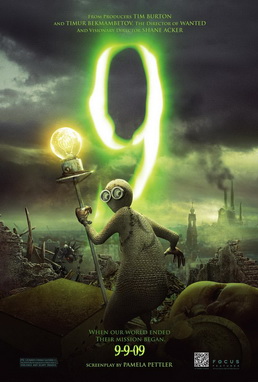
9, A Review

A few days ago I went and watched the movie 9. You may remember me mentioning something about it a few weeks ago. I particularly wanted to watch it in theatres, as the big-screen sounds and animation for such a movie is something that a home theatre cannot hope to compare to. The movie is directed by Shane Acker, produced by Tim Burton, and features the voices of Elijah Wood (9), John C. Reilly (5), and Jennifer Connelly (7).

The film begins with 9, a stitchpunk doll, waking up to a desolate world, ruined from war and devoid of life. A scattering of machines walk the harsh landscape, all the time looking for any signs of life (presumably that's what they're doing). 9 spies a group of other stitchpunks walking on the horizon, and he makes his way out of the destroyed building, grabbing a mysterious looking object before he leaves.

This starts a journey that is epic in scale, as the fate of all life is put on the battlefield. There are 9 total stitchpunks, and each one is unique and special. Together they must overcome difficulties and restore life to the ravaged world.

To me, watching 9 was like watching a movie version of a video game. The characters can rummage through the piles of junk and customize their weapons or apparel, there's a archetypal antagonist, and the quest to save life fits in there perfectly.

I had two major problems with 9. First, I felt that the characters were all mostly flat and stereotyped. The hero is 9, a young idealist. The other stitchpunks fall neatly in line. There's an untrusting one. There's a mean brute. There's a few kind and trusting ones. There's a wizened pair that have the answers to questions. There's a love interest for 9. There's a crazy one, who somehow has the answer to the mysterious object 9 took from the beginning. And the machines are all just wanting to wipe out all traces of life. The characterization for this film fell short, and I didn't feel any connection to any of them.

The second problem I had was that the movie didn't seem to have much of a plot, or a backstory, either. Sure, the characters did things, but the things they did were mostly dull and not too exciting. And when they did important things, they were predictable and expected. Even the ending was predictable. And the backstory, which had potential, was typical and lacking sufficient explanation.

Despite the flat characters and the less-than-stellar plot, the movie wasn't all in shambles. The film was an absolute joy to watch. The CGI is amazing. The unique post-apocalyptic art style the designers were shooting for worked superbly, and I enjoyed seeing the art in action. The stitchpunks each have their own individual design, and every one of them were cool to look at. Some of the inventions they come up with are also pretty impressive.

Overall, I paid $6 for a matinee ticket to an okay movie. Was it worth it? Yes. Did I learn anything or feel anything special from watching it? No. Nothing new, anyway. Terminator, The Matrix, and WALL-E have already taught us not to put too much stock in machines, and that they'll eventually turn against us. Would I recommend this to you? Yes, and no. If you want to see some pretty cool artistic ideas in a bleak world and you don't care to spend money on that, go for it. If you're looking for an epiphany, you may have to try something else.

On a side note, doesn't that Fantastic Mr. Fox look awesome?