Tuesday, February 21, 2012

The Great Somnambulist Faces His Fears

When Millard Filmore banged on my door this morning, the clocks in the attic all read a different time.
3:13     4:00     7:30
6:51     2:01     9:45
8:88     0:00     x:92
12:12     hellomoto
12:00     3:13     5:14
1:19     6:52     4:28
I think it has something to do with the President's time traveling abilities, but my clocks always go haywire whenever he shows up.  "Logan," he says, his voice heavy and augmented, not like Darth Vader's, but smoother, more velvety, as if his larynx has been marinating in honey all night.  It's impossible not to hear and listen to his words.  The dog is with him, Wolfie, she is called.

"Sir," I reply, cringing at how coarse my voice sounds compared to his.  I had been asleep, dreaming of Martin Luther King and Mama Cass Elliot.  They were singing a rousing and puzzling mash-up of "Dream a Little Dream" and the famous speech of Dr. King's.  It was getting to the good part, too.

"The Great Somnambulist has slumbered for much too long.  It is time."  I wondered at his word choice and whether he was being ironic or coincidental.  And he stared at me with those haunting eyes, lifeless and pale.  I quivered down to my soul then.  How can I explain it?  It's like the feeling you get when you're reading a 160 year old book that's been translated from its original Russian and you come upon a piece of dialogue that spans three pages but only one paragraph.  You wonder how people spoke with such eloquence and at such length back then, and you feel sorry for those in their presence.  The diatribes against God and Man and Society had to get old.  If you understand my meaning, that's similar to the dread I felt.

He held out his hand and I took it, trying to find something else to look at besides his eyes and failing.  With a sucking-slurping sound and a burp, the wormhole opened and we shimmered.

"What will happen in the third season of Downton Abbey?" I asked him.  "And will the ridges on my tongue and my hard palate cool back down?  You see, in my haste yesterevening I bit into a slice o' pizza that was much too hot, and in doing so the sauce--cursed tomatoes!--scalded me most severely.  Because of this I have been out of commission, so to speak, though not out of mind, lest you think I already was out of mind, but I would implore you to think otherwise.  Consider this.  Would a man out of mind successfully argue himself sane by brevity or would he ramble on and on about it, summoning up a panel of peers and contemporaries to support his claims that he was, in fact, quite sane?  Hmm?  I ask you, President Filmore, do you see my reasoning?  I think you do, and I will leave it at that.  But what about the pontifex?  What about the Gilmore Girls?  Is this about the seismograph again?  That wretch Claudio Montezuma assured me that he saw Mr. Julius McPeasy accompany Count Flopsy back to the vaults with it.  No?  Is it Cornelius Antonin Scruzz then?  Has the lad been found?  I had given up hope on that."

We were in the gardens, strolling through the rows of squash and onions.  I was bumbling like Fyodor Pavlovich Karamazov.  Time travel affects us all differently.  Do all computers insides look so clunky?  Are all motherboards created equal?  Can we replace our RAM if we're running low?  Do you sulk and slink in the shadows when you trespass?  Does snow exist any longer?  Will the Counting Crows new album be any good? (I hope yes.)  Will Skyrim ever end?

All of this and more I wondered.  Finally we reached the end of the squash and President Filmore stopped.  Before us I saw a pedestal composed of Irish Spring soap.  In the milky moonlight the soft green was incredibly beautiful.  Atop the pedestal was a housecat lying on its back, paws out before it.  Resting on the paws was a plate, elegant yet simple.  And on the plate was....

"You know what you must do," said the silky voiced President.  I stepped forward.  My hands were shaking.  "The Great Somnambulist must not be allowed to give up so easily," he said behind me.  His words put fire in my bones, and with resolve I took the pizza into my hands.  Pepperoni.  Black olives.  Mushrooms.  Peppers.  Few onions.  Cheese.  Bacon.  I rubbed my tongue against my hard palate and winced.  Are rhinos things of the past?  Will I ever be free of soda?  I bit, and as the pizza sauce exploded in my mouth, the pain I once felt vanished and in its place came euphoria.

Monday, February 20, 2012

Resolution for Men, a Review


The Resolution for Men is not the kind of book that I would normally read.  In fact, I think I've only read one book like it before, John Eldredge's Wild at Heart, and that as a single lad in college.  Now, with nearly five years of marriage under my belt, and almost a year of being a father, books like Resolution seem more appropriate.  Resolution, written by brothers Stephen & Alex Kendrick, is an accompanying resource book for last year's Courageous, a quasi-companion to Fireproof.

Point blank, I've seen neither of these movies, though from what I hear, they're "wonderful."  Personally, I just don't see the appeal.  I get that Christian movies are clean and wholesome and powerful and filled with a message, but generally the acting and budgets are not comparable to a Hollywood powerhouse.  Now I'm not knocking these movies, and I'm glad that they exist.  No, what I have problems with is the fact that the movie is labeled as a "Christian" movie, relegating it into a genre that's typically laughed at and ignored.  Anyone who's read this blog very long knows that I dislike labels and genres, whether it's for film or books or music or whatever.  If you want to reach a larger audience then remove the genre classification.  Until then, we'll remain a splintered people, separated by race, religion, and many other things.

With that said, Resolution is a non-fictional book about what it means to be a Man.  To be a good husband.  To be a good dad.  Or, from the Introduction,
This book is an unapologetic call for men to live courageously for their faith and their families.  It is designed to strategically challenge you to become the man God created you to be. (page1)
Continuing my confession, I would very likely never have read Resolution on my own.  It's just not my norm.  As it so happened, my Wednesday morning D-group (which we affectionately call "Coffee Talk") decided to read this book together.  What's more, we decided that after we finished that we would pledge the "Resolution" the book provides, affirming our intentions publicly and in the presence of others.  This Resolution is the focus of the book, as it precedes and concludes the text.  Each of the fifteen chapters point to the twelve points made in the "Resolution", and all build upon one another as expected.

To make things even more difficult, I literally started reading the book a day or two before my dad died.  Because of the book's content, my mind had been thinking about him a lot at the time.  Thinking about how he was never there for us and how little he was involved in my life.  The book speaks of being a chain-breaker in your family, and I had a clear goal in mind for my life of how not to be.  Reading the book was cementing the way to that goal.  Then he died, and all the difficult parts about fatherhood were suddenly clearer and made more of an impact.

I came into Resolution with no real expectations, what I found was a book containing a lot of great information about being a Man of God.  I like to read with ink pens and highlighters at my disposal, and this book shows it.  Many of the pages are scribbled with notes or underlines, things I found particularly insightful or applicable.  Consider (and I apologize for the quote-dump here),
*All sin in us reveals that God is not as holy to us as He should be. (p89)
*[And] the more maturity a man has, the more responsibility God can trust him with. (p62)
*If you want to get to the core of who people really are, get them to start talking about their dad. (p14)
*God's Word commands husbands and fathers to lovingly lead their homes. As men, we are to walk in honor and integrity and fully embrace our responsibilities as shepherds over our families. We are called to model a loving, Christlike example for our wives and children... Therefore--because this is God's calling--it's no mystery that a godless culture would mock and constantly undermine fatherhood, attacking and inverting what God designs and values. (p13)
*Strong relationships and marriages don't happen because people never hurt each other. They happen because the people involved keep on forgiving. (p172)
*Being a Christian once meant faithfully and boldly representing Christ, even when it came at great risk, even when it meant being unpopular. But too many men today have redefined being Christlike to mean "nice and quiet." (p137)
This is just a smattering of things I marked.  For you see, Resolution offered much more than I was expecting.  Not only did the authors give theory behind things they recommended, but they went beyond that by offering practical things to do.  I appreciate reading a book with suggestions for how to apply to my life.  Too often, it seems, that these books only offer us reasons why we need to do things a certain way but not how to go about it.  

I've already mentioned the "Resolution" at the front and back of the book, but it's worth mentioning again.  I think the desire of the authors is to get men to recommit themselves to seeking a lifestyle that's reflective of biblical manhood.  The Resolution is a solemn compact that should not be entered into half-hearted.  I imagine that there are some who have qualms about making that type of commitment and instead just gloss over that part of the book, but as for me, it's something I'm going to do.  The Resolution is composed of great points that not only will make us better men, but will draw us closer to God.

Stephen & Alex Kendrick's Resolution for Men is not a perfect book.  There are plenty of instances that I completely disagreed with, where I felt that they were being too legalistic or too dogmatic, but these were uncommon.  At times I also felt like they were repetitive in their message, but this could be that they just wanted to make sure that their message was heard.  Even so, these brothers are to be applauded for the book they've produced.  It's poignant and much needed in modern day America.  If you're wondering what it takes to be a better husband, a better father, and a better Man in general, then let me suggest checking out  The Resolution for Men.

[Note: Just in case you're curious, there's also a Resolution for Women out there.  I can't attest to its content, but if it's like this one, then I do recommend it, too.]

Wednesday, February 15, 2012

Wrestling With: Reverence & Respect

Recently I was part of a frustrating exchange.  An elderly man in our church expressed his disappointment in seeing someone wear a hat inside the sanctuary.  What's more, the culprit was a minister.  (No, this wasn't at my church, but was at another church in a video we were watching.)  The elderly man proclaimed that there's not any reverence anymore, no respect of the pulpit or of the church or anything.  He acknowledged that yes, the church is not the building, but even so, it should be respected*.  To complicate the matter, two other people joined in and supported him.

Through it all I felt a growing sense of unease.  How can people think that the clothes they wear are an indication of their heart and its relationship to Almighty God?  We all know that "clothes don't make the man."  That's been around forever.  Eventually I was asked my opinion, and I said that I disagreed with them and that I saw no problem with it.  I went on to say that God doesn't care what we wear as long as it's modest and not causing someone else to sin or laced with profanity.  He looks at our hearts.  Our respect/reverence of Him has nothing to do with what we're wearing in church.

Growing up in rural Kentucky, my home church had a dress code.  For males, blue jeans or pants were to be worn at all times; females had to wear skirts or dresses.  Shorts were never allowed.  This was how I grew up, and how I thought for much of my life.  I never bothered to ask why.  It was one of those "that's just how it is" things.  Along those lines, American history shows plenty of examples of men taking their hats off before entering buildings, opening doors for women, and being generally "respectful."  Culture defined respect, and like any good Baptist, this turned into a tradition, albeit lacking any biblical support.

I was given some stern looks and questioned about my opinions.  The problem with America, I was told, is that we've progressively compromised our stands and allowed liberal theology to overtake us.  I can agree to some extent with that, but not in full.  Too often people hold to the "God is an unchanging God" mentality, that He's "the same yesterday, today, and forever" and that means that we should be the same, too.  The problem with that is that it limits how you worship God, who creates a new day every morning, who's crafted a world filled with beauty and impossible splendor.  The world is changing, just as God knew it would, and holding on to pointless traditions are inefficient at best, and downright wrong at worse.

The bride that Jesus died for is built on the Word of God, not traditions.  Traditions can teach, and there is wisdom found in them, but they are not God's Word.  Whenever the two butt heads, I'm going to choose the bible every time.  It bugs me when people say "I believe that..." or something similar.  What we believe has no matter when compared with what God says.  The bible speaks plenty on respect and honoring God.

  • The fear of the Lord is the beginning of knowledge. -- Proverbs 1:7
  • The fear of the Lord is the beginning of wisdom.  -- Psalm 111:10
  • Worthy are you, our Lord and God, to receive glory, honor, and power... -- Revelation 4:11
  • Honor your father and mother. -- Exodus 20:12
The bible teaches in being reverent to God.  The bible teaches that I should live out my life in fear of Him, and that that fear is healthy and humbling.  The bible teaches us that as we fear Him then He blesses us.  Jesus taught us that people should respect one another and love one another and that our respect and love toward one another is reflective of His love to us.  The bible does not teach that wearing a hat in church is disrespectful or wrong.  That means that we can serve and worship God in a three-piece suit as easily as we can in gym shorts and sandals.

It seems to me that the Generic American Church of Denominations has a mixed bag when it comes to things like this.  We have our traditions and our practices, things that are obviously American and rooted in our grandparents and great-grandparents days, or all the way back to the Pilgrims even.  We hold fast to these things, convincing ourselves that they are right and God-breathed.  On the same hand, we cling to biblical cultures and practices when it's convenient, eager to apply verses out of context.  This double standard is frustrating and foolish.  It brings to mind James' words 1:8, "A double-minded man is unstable in all his ways."  Man cannot be double-minded or else we're called a hypocrite.  The same goes for the church.

I just wish people would wake up and realize this.  I'm just as guilty as anyone else, blinded by my own opinions and biased to my own thinking.  But I'm honestly trying to base my opinions on the bible, not on traditions or culture or some pastor or the latest book or anything else.  God's Word is the only source of truth that we have.  The rest is just empty words.  Now I'm not saying that we should just throw out the way that we do things, but I am saying that we should think about the way that we do things.  Are we scriptural in our practices?  And even deeper, even if we don't say anything, are we silently judging somebody else because they're doing something out of the norm or worse, something we disagree with?  I'm wrestling with being as biblical as I can in my life.  I hope you are, too.

-----
*Why?  Why are buildings worthy of respect?  God no longer dwells in a tabernacle or temple.  He sent His Spirit to us, which dwells in our hearts.  So again, why treat the building as something holy?

Friday, February 10, 2012

Just After Sunset, a Review


My relationship with Stephen King is limited.  I've read the entire Dark Tower series, and enjoyed it very much.  Back in high school I read The Green Mile and a short story collection titled Everything's Eventual.  I think that's about it.  I've had The Stand on my TBR for a good while, but I've never managed to crack it open.  So when I received Just After Sunset from my sister last year on a loan, I placed it on my shelf and figured I'd get to it whenever I did.  As it turns out, it was sooner than later.

Just After Sunset is King's fifth collection of short stories.  There are thirteen stories within, which seems appropriate given the subject matter.  I figured the pieces would be horror, but most of them came across as suspenseful or eerie to me, and not a one crossed the line into horror.  Okay, maybe one or two, depending on what gives you the willies.  

As I did in my review of Neil Gaiman & Al Sarrantonio's Stories, I've written a brief review/preview of each story.  (Actually, these are my unedited notes I took after I finished a story.)  At the end of each mini-review  I've given a rating based on the GoodReads scale.  I've boldfaced the stories that I would recommend.

-----

"Willa" - This is a beautiful little piece is about a man named David and his fiance Willa. David and Willa are in a group of passengers waiting for an Amtrak train to come and pick them up from a layover in a sleepy little town in Wyoming. It's late, the train should be there soon, and David notices that Willa is missing. He sets out to find her, only to discover something else entirely. 3.5-stars

"The Gingerbread Girl" - After Emily and Henry's daughter dies in her crib, the couple begins to drift apart. Emily takes up running, to an obsessive degree. Eventually the two separate, and Emily heads to the Gulf of Mexico, to stay at her dad's tiny conch shack while she clears her head. She keeps up her running, more and more each day, until one day she notices what looks like a dead body in the trunk of a neighbors car. This is a pretty standard abduction/escape story that, while exciting, was rather dull and uninspired. It was difficult to read, too, considering I currently have a daughter that's sleeping in her own crib now. 2-stars

"Harvey's Dream" - Janet and Harvey have been married for many years. She's grown rather dissatisfied with life and her husband. As she's looking at his pasty white legs at the breakfast table one morning, Harvey tells her about his strange dream from last night. What follows is uninspired and mostly boring. 2-stars

"Rest Stop" - John Dikestre is a writer working on a new story. At a rest stop late one night, he encounters a man abusing his wife/girlfriend, and John muses whether or not he should interfere. 2.5-stars

"Stationary Bike" - Richard Sifkits, widower and artist, has just been told by Dr. Brady that his cholesterol needs to go down. Dr. Brady gives Richard "the speech" about aging and fats, and eventually Richard decides to buy a stationary bike. At first, riding fifteen minutes was a chore, but as time goes by, Richard has to set alarms to remind himself to get off. For when Richard Sifkit's is on the bike, his mind takes him places that may or may not really exist. 3-stars

"Graduation Afternoon" - Very forgettable and kind of boring. Seems to be written with 9/11 in mind, possibly? About a girl getting ready for a graduation party, planning her future and that of her dull but wealthy boyfriend. 1-star

"The Things They Left Behind" - Scott survived 9/11, but he has horrible secrets, horrible memories, horrible dreams, horrible visions. He skipped out on working that day, and everyone in his company died but two. Scott Steely is a man with survivors guilt and a box full of things that were left behind by the victims: a conch shell, a lucite cube, a mushroom, a whoopee cushion, and some sunglasses. Their arrival is a mystery, and he finds that he cannot get rid of them. This story was wonderfully written and reflective, even if slightly vulgar. 4-stars

"N." - Can a story get inside your head and change you? Can you believe the words of an OCD madman? Psychiatrist Dr. John Bonsaint recounts his testimony and experience with a delusional patient referred to as N. This story is a framed story, where Sheila, John's sister, writes to a childhood friend of John's about the doctor's recent suicide. After his death, John's patient notes were discovered marked with "BURN THIS." Sheila's curiosity got the better of her, and what follows is a strange story that is gloomy and haunting. Reminiscent of House of Leaves, this tale is a great descent into madness. 4.5-stars

"The New York Times At Special Discount Rates" - While getting herself together in her bedroom, grief stricken from the death of her husband, James, Annie gets a phone call. When her husband starts speaking on the other end, life takes an upside down turn. This was a short but enjoyable piece. 3.5-stars

"Mute" - Monette recounts a mysterious confession to a priest. This is another frame story, where Monette's wife's infidelity at age 54 has been found out. Not only has she been cheating, but she's also been embezzling. So when Monette picks up a mute and deaf hitchhiker, he finds the perfect companion to vent to. This was quite an intriguing story. Fun. 3.5-stars

"The Cat from Hell" - Halston is an independent hit man. When an aged and wealthy man offers him a hit for $12k, Halston takes it. When the man says that the target is a cat, Halston shrugs, unconcerned. He's killed plenty of men before, never caring about the reasons behind the hits. He figures the cat's just another target like any other. What he finds is something else entirely. This was a short and fun story, albeit bizarre. 3.5-stars

"Ayana" - A narrator tells his story of how he watched his father's miraculous recovery from pancreatic cancer after a small girl kissed him. From then on, the narrator found that he, too, had the gift of healing, and this story recounts some of what he's done over the years. I found this piece kind of odd and out of key with the others, not really seeming to fit. Plus, there was no action, just a very passive memoir like tone of things that had been done. An interesting idea that wasn't developed enough. 2-stars

"A Very Tight Place" - Curtis Johnson has plenty of hard feelings over his neighbor, named TMF for short. TMF had an electric fence, which killed Curtis' dog. Curtis wants recompense and revenge. This story was exceptionally colorful, filled with so much profanity that my eyes bled, and enough vulgarity that I nearly quit the story several times. I wish I had. This story is absolutely disgusting and gross, and I cannot imagine what Stephen King was thinking when he wrote this. I was compelled to keep going just to see how everything would resolve, even if I felt dirty and wanted to throw up. The premise is that Curtis is lured to an abandoned construction site and left to die in a tipped-over portajohn.  1.5-stars
-----

As you can see, for the most part, I was around the 2-3.5 range.  The arithmetic mean of these stories is 2.8, which is just below the "I Like It" 3-star rating.  The three bolded stories are all very good, and I can easily recommend them.  In particular, "N." was a delight to read, and "The Things They Left Behind" was one of the most powerful 9/11 stories I've read.  I really loved King's take on that day.

If you're looking for some short fiction, Stephen King's Just After Sunset has some gems, but it has some unpolished stones, too.  There was potential in a few, and some were just flat out boring.  All in all, I liked the read well enough, but I could have liked it better.

Tuesday, February 07, 2012

Murder-Suicide

I'm moved beyond words and coherent thought.  I wonder how someone can be so selfish?  So delusional?  How does saying "I'm sorry for all the hurt I've caused" lead to causing more hurt?  How can a man take a hatchet to his two sons, ages 5 and 7, and hit their throat, causing them unimaginable pain and suffering?  How can he then explode/burn his house down, killing himself and his kids from carbon monoxide poisoning?  And why does the picture have to be of a happy looking family?  It literally sickens me.

I've never saw the appeal of suicide.  But what's even more baffling is when suicide leads first to murder and then the checking out early.  Is there some great failure as a people that leads to the taking of one's life?  Is there an offense that finally cracks the shell of a person's heart?  Have we, by and large, been too aloof, too absent, and too selfish that we miss all the signs?

Oh God how it hurts me thinking of those boys.  Their confused minds as their father grabbed them, pulled them in, and wounded them.  I can only imagine how their hearts broke at the betrayal of the man that birthed them.  And the man.  What led up to that moment?  Was he slighted at work?  Was he abused?  Was he bullied as a child?  Was his heart simply filled with brackish blood?  Surely this was not his ideal.

These types of news stories have a profound impact on me.  They make me want to pull Keisha in close, squeeze her tight, and tell her just how much I love her.  They make me want to pick up Avonlea and kiss her until she scratches my face off with tiny baby nails.  Not only do this, but they bring into focus how important it is that I be the kind of father I'm supposed to be, to be the kind of man I'm supposed to be, and to be the kind of Jesus follower I'm supposed to be.  Am I invested in people?  Do I notice when something is going wrong in someone's life?  Do I truly, honestly care about Jonathan the Starbucks cashier on Wednesday mornings?  Or what about William the Franey's clerk?  I care enough to know their names, but would I be able to see it in their eyes if something was wrong?  Would I miss them if they stopped showing up?  What about you all, other bloggers that I know only through the Web.  Would I be able to infer something was wrong in your lives?  Would I be able to offer any support?  Would I miss you if you no longer commented/posted?

In the midst of life's maelstrom, especially this week's tumultuous seas, my heart is at peace, but it's tenuous. It's the kind of peace that's rooted in eternal joy, not immediate happiness.  It's the kind of peace that if fraught with burdens and sorrow, for the pain in others overwhelms so.  It's a peace like David's, who called out to God in the Psalms time and time again for deliverance and rescue.  While my personal pain and angst may be relatively shallow, there's a world that's filled with anguish.  I want to do my part to lessen it.  Pray for that family tonight.  They definitely need it.  And if there's anything I can pray for you about, just let me know.  I'll do it.

Wednesday, February 01, 2012

Current Updates & Link Love


(Because I haven't put a picture of Avonlea up here in a while.)
  • Keisha is blogging now.  She's chronicling motherhood and Avonlea.
  • I bought my PE CERM12 manual the other day.  Truly defines what a tome is.  According to Amazon, it weighs 6.7 lbs and is 1552 pages.  I'd guess closer to 10 lbs and 1600 pages.  I'm already dreading the studying it's going to take to pass that darned test in October.
    • Oddly enough, this does not count as a book purchase for my 2012 Manifesto, as it's not really a book to read, per se, but a book for work.  Kind of.
  • February is here and I'm making headway with my TBR.  I've been doing a lot of comic book reading, but also quite a bit of STAR WARS novella work, too.  All have been quick, fluffy reads.  I should probably break that up for when I start The Brothers Karamazov, but I doubt that'll happen.
  • Anyone else use freegal through the library or Noisetrade?  I've been getting a lot of top-quality, free songs of late.
  • I was asked to play guitar for a little concert at a coffee shop this Saturday night.  Makes me a little nervy playing in public like that.  I said sure, cause I just like setting challenges for myself and rising up and above mediocrity.  Being out of my comfort zone is getting easier and easier in some areas...
  • Last Saturday we had a most amazing night of worship.  A few weeks ago we were talking about things to do to become a more biblical church*.  Worship is a lifestyle, and praising God should not be confined to only Sunday mornings.  So we created WORSHIP 8:03.  Our goal was to create an environment solely dedicated to worshiping God however you wanted.  My part was playing guitar and helping lead worship on stage.  We had 30-40 show up.  There was an open communion.  I think it's safe to say that there was a general spirit of unity and worship among us there.  I know I loved it, just praising my Creator and Savior, thanking Him for His love and mercy.  It was much needed.  In fact, we're already planning our next one for March.
  • I was contacted about having one of my reviews used for promotional purposes.  I said yes, and if it goes any farther, I'm sure I'll put it up here.  Until then, I'll just stay hush-hush about which book.
  • Omelets are without a doubt the best breakfast food.  Thankfully, Art of Manliness has put up a new article on how to make better omelets.  (Sometimes mine are great, sometimes they look like a cat threw up in a skillet.)  This is a companion to their most excellent "How to Make Better Eggs" post from a few months back.
  • I finished reading my chronological bible reading plan yesterday.  Took eleven months.  Here's the new one I'm starting tomorrow.
  • Much more going on, but I'll just keep all that quiet for now.
-----
*Yes, I realize that "church" in this sense goes directly against my principles.  Nevertheless, it's another example of an English word that has multiple meanings and falls apart under minor scrutiny.  In general, whenever I mean the "church" as the bride of Christ and a unified, global body, I prefer to write "Church."  Whenever I mean a localized, unified body, I again prefer "Church."  When I mean the building where the Church goes to, this I refer to as "church."  

Monday, January 30, 2012

Daredevil 2.3 - Wake Up


Wow. I knew Brian Michael Bendis was praised as a comic writer, and now I see why.Wake Up, Volume 2.3 of Daredevil, is deep and powerful. But as good as the writing was, the story was just as much artist David Mack's work as it was Bendis'. 

Ben Urich is a Daily Bugle investigative journalist sent by J. Jonah Jameson to report on the "Crime of the Century." Instead, Ben stumbles upon something more important, at least to him, and that's the story of a boy named Timmy. Timmy is shocked into a catatonic state by witnessing something horrible. Something involving his missing dead-beat dad.  Something about Daredevil.  He spends his time in a hospital drawing comics and generally ignoring the world around him.  

As Ben digs deeper, he begins to ache for Timmy and does everything in his power to help the boy. But what's more, Ben wants to know what's caused his pain. 

I loved Wake Up, and it definitely is the best of the Daredevil comics so far. While not as flashy and showy as most superhero comics, and definitely nowhere near as light, it's a wonderfully drawn and written story.  And ultimately we get to see more character development from Daredevil to Ben Urich, whom I'd never heard of. 

I have to take a minute and address Mack's art. The styles are constantly changing, and the fluidity really adds to the mental state Timmy is in. Characters even look different from panel to panel. I'm tempted to say that this may be one of the best looking comics I've ever read, and that's saying something. It's obvious how much work Mack put into these four comics, as they're quite mesmerizing. 

Daredevil 2.3: Wake Up pretty much stands on its own as a story. No prior knowledge of the Man Without Fear is needed, but it would add to the depth of the tale. Nevertheless, if you're itching to try a Daredevil comic, then I can easily recommend this 4-issue run. Here's to hoping Bendis can maintain this standard I've set for him.

EDIT: Even though I just read Volume 2.2 recently, I didn't make the connection that David Mack, the artist for Wake Up, was the writer for the fantastic Parts of a Hole.  Looking back, it's easy to see Mack's influence on the storyline of Daredevil and Echo.  Not only that, but Mack was the cover illustrator for those comics as well, which I thought were excellent.  I'm going to have to keep my eyes open for this guy.  He can write and draw...

Friday, January 27, 2012

Uncle Montague's Tales of Terror, a Review


Christopher Priestley's Uncle Montague's Tales of Terror is the kind of book that begs to be read aloud, with a British accent, and in the dark of night sitting next to a roaring fire while an unnatural storm brews outside.  This book is an anthology of ghost stories and cautionary tales, all told by the mysterious Uncle Montague to a rather dimwitted nephew, Edgar.  Most leave you with a crooked smile after finishing.

Uncle Montague's home is filled with odd collectibles.  An old brass telescope.  A gilt frame.  A small Indian ink drawing that may or may not move.  These and more all have a story to tell, and not a one of them is happy.  In fact, the words "ghastly" and "terrible" came to mind more than once.

Uncle Montague tells Edward ten tales over the course of the evening.  All take place within the frame of Edward and Montague reclining near a fire place in Montague's moody home.  Noises break into the frame, setting the stage for something else that may exist outside of the stories.  Most of the tales feature young children as their protagonists, and because of this, the horrifying aspects of Montague's tales is multiplied.

Enhancing the book and each story is illustrations in the style of Edward Gorey's Gashlycrumb Tinies.  In fact, the stories read as if they were directly inspired and lifted from one of Gorey's panels.  David Roberts, however, is the illustrator for the book, and his work is so memorable that I can scarcely think about Uncle Montague's Tales of Terror without thinking of the delightful illustrations.

It's hard to pick a favorite story here, as all were great for one reason or another.  I particularly enjoyed the ones below.

"The Demon Bench End" is truly horrible.  Young Thomas Haynes is not really a very good boy.  For all appearances he is, but truthfully, he's just as bad as anyone else.  After a fateful street side encounter with a tinker, Thomas's life forever changes.  Largely neglected by his father, Thomas stands idly by while his father and the tinker haggle.  Eventually the family parts from the riffraff, but Thomas does not forget what he saw.  For the tinker had something Thomas wants terribly bad, and he'll stop at nothing to get it.


"Winter Pruning" is one of the more twisted tales of Uncle Montague's.  It's a very traditional child's story.  There is an old blind witch that lives miserly at the top of a hill.  All day long Old Mother Tallow stands out in her yard pruning her trees, mending the apples.  Simon Hawkins, another young rapscallion if ever there was one, decides to sneak into Old Mother Tallow's house one day while she's outside.  The witch is supposed to be rich, after all, and he was sick of stealing pennies from his mother's purse.  One big score would be all he'd need.

"A Ghost Story" was probably the most lighthearted of the tales, and that could be partially why I liked it so much.  Little Victoria Harcourt begrudgingly attends a family wedding, a horrible affair where rain and wind ruins the day.  Victoria is mostly scorned by the other girls, and when her most loathsome of cousins Emily begins telling a ghost story, Victoria is almost ready to abandon all pretense of wanting to fit in.  I don't want to say much about this story, but I did enjoy it immensely.  I smiled like a baboon at the end.

In the end, every story in Uncle Montague's Tales of Terror was exactly what I was looking for.  While some are better than others, all are perversely wicked.  One can't help but feel a trifle ashamed at the outcomes of these tales, for smiling at the often demise of children.  Priestley's stories fit into the vein of the Brothers Grimm, though not as fantastical or folky.  There are lessons to be learned beneath these stories, making it a perfect book for adolescents and teens.  Even so, Priestley offered a memorable book that's quick to read and perfect for when the Halloween mood strikes.  I'll be adding the other installments, Tales of Terror from the Black Ship and Tales of Terror from the Tunnel's Mouth, to my TBR now.

Wednesday, January 25, 2012

Jeff VanderMeer's "The Situation" as a comic on Tor.com


Possibly the most enjoyable read for me in 2011 was Jeff VanderMeer's The Third Bear.  It blended weird with brilliant prose and wonder, and I think fondly of the book.  Today, Jeff VanderMeer and Eric Orchard have released Part 1 of 3 collaboration to re-tell a short story from The Third Bear titled "The Situation."  From my review,
"The Situation" is baffling. Part office-life, part post-apocalyptic, part Idon'thaveaclue, this story sealed the deal for me. I read it after reading "The Third Bear" (which I recommend you do as well, even though it doesn't follow the story in the layout of the book) and noticed a few coincidences that I could not ignore. I'm not sure at all how to describe what's going on in this story, but I highly recommend you read it.
The artwork by Orchard is phenomenal.  It's style fits exactly how I imagined VanderMeer's world, capturing both the mood of the story and the horrifying beauty described therein.  If you've not read VanderMeer's book, then you really should.  It's so unlike anything else I've ever read.  What's more, if you love good art and a captivating story, then check out Tor.com's "The Situation."  No background knowledge is necessary to enjoy the tale, though it probably makes understanding it a little easier.  I'm looking forward to seeing the remainder of the story.


------
Images are from Tor.com, created by Eric Orchard.  For more, follow the link here.  And while you're at it, Ken Scholes' If Dragon's Mass Eve Be Cold and Clear was another excellent freebie posted up on Tor.com.  Part post-apocalyptic, part haunting tale of hope, this story had Santa as a sword-wielding, Christ-like myth.  I thought it would be silly.  I was dead wrong.  Just reminds me that I really need to read Scholes' novels, as I've been more than pleased with his shorts I've read.

Tuesday, January 24, 2012

About Google Music

I've been using Google Music since it came out of Beta, and for the most part, I've been very pleased.  Basically, it's a music streaming site that runs on cloud storage.  It was cloud storage that I wanted to try, since Stewartland1 is turning 8 years obsolete this May, and Stewartland2 is only slightly younger.  Because of this, memory is something of a problem, and I have a lot of music (around 50gigs or so).  Thus, the cloud storage.

Google Music merges with your Google account and allows the user to listen to his or her music anywhere they can sign in (as long as flash is supported).  That means that if I had a droid phone then I could listen anywhere.  That also means that I could listen at work and at home without having thousands of songs taking up hard-drive space.  This was my chief reason for signing up, well, that and my infatuation with Google's products.

I've been mostly pleased with my Google Music experience these last few months.  The player links to a Google market where you can purchase songs and albums at competitive prices, ranging from FREE to whatever.  I've not bought anything above $0.00, but what I've got from here has been good.

The only problems I've encountered have been listening at work.  My computer at work is older than Stewartland1 and the internet connection isn't as good, so I get occasional freezes.  Still, as long as I'm not doing anything too computationally intense, everything runs smoothly.  The only other issue is the randomizer used seems pretty bland, especially when listening to just one artist.

Google Music is not a streaming radio like Pandora, unfortunately, and I think this would be one area Google could improve.  Still, if you're on the go and have a droid, using Google Music seems like a smart idea.  Or, if you're like me and have limited storage space, it's a no brainer.  It does take some time to upload your music, but once it's there it's there for good.  Currently you can upload 20,000 songs for free, with pricing starting above and beyond that.

Friday, January 20, 2012

Flash Fiction Friday: The Clean Man (A Study of Mostly Realism)

THE MAN leaned back in his chair, cautious not to go too far.  Wouldn't want the back to break after all.  He idly wondered to which back he was referring, but then shrugged it off, not really caring.  He picked up his coffee, bitter with only the slightest taste of artificial hazelnut cream somewhere in its black depths.  Steam rose from the mug, hot and refreshing.  Probably the only warm thing in the whole room, he thought.  As he returned the cup to the table some liquid splashed over the side.  Brown stains freckled paper.  He winced at the accident, critical of himself for the mishap.  He was a clean man.  A tidy man.  A man who took pride in organization and order.  Accidents were things that happened to others, not to him.

Scowling at the drying stains, he blotted the coffee up with a folded paper towel.  He could no longer reuse it, as was his custom.  Paper towels were luxuries many could not afford.  He, on the other hand, had stockpiled a basement full, affordable at the time in thanks to his wife's coupons and his cunning.  A clean man must have towels, he thought.  He glanced at the clock.  0741.  The spill had altered his routine by a full minute.  Not a problem to most, but he was a punctual man, leaving home at 0748 every day, arriving to work at 0759, and at his desk by 0800, usually beating his boss and everyone else to the scene.

He dropped the paper towel into the bin, frowning as it disappeared from sight.  The man returned to the table and gathered the papers, organizing them neatly.  He moved to his desk and placed them in their proper cribs. 0743.  He had to go.  He could already see the horrific traffic accident, detouring the roadways, pushing his arrival time back by several minutes, if not hours.  If he was lucky, he thought, he would be in the crash, and then he would not have to endure the patronizing glares of tardiness.  A perverse smile came unbidden at the grim thought.

The man topped off his coffee mug, filling to the prime place just below the rim of the cup.  He screwed on the travel lid.  I'd like to see you splash about now, he thought smugly.  0748.  He really had to go.  The man scooped up his jacket, throwing it on like a smooth and well-practiced machine.  "Off," he said, and the overhead lights began to dim.  As the door slid closed behind him, the man had a peculiar feeling of despair.  He paused and did an inventory count.  Lights.  Phone.  Wallet.  Keys.  Coffee.  Something was different, he knew.  Something was off.

The man arrived to work without accident.  He quickened his pace as he entered the gates, ready to be in his seat and about business.  The nagging sensation still poked at him mind that something had happened, but for the life of him he couldn't figure out what it was.  The office was still dark.  Good, he thought.  "On."  The lights remained unchanged.  Frustrated, the man spoke again.  "On, please."  Nothing happened.  He sighed, agitated, but did not let it deter him.  Someone else would fix it.  He was a clean man, not an electrician.

He thought nothing of it that his computer was already on and lit.  On any normal day, the monitor would be awaiting his password entry.  Today, however, the man was greeted with a different screen.  Fingerprints smeared across the glass, greasy and yellowed.  A rag was in a wad atop his keyboard, soiled and smelling of rot.  The man stared in horror at the scene before him.  Papers were everywhere, many torn to shreds or mutilated.  His inkwell had been unstoppered and its contents poured onto his seat.  A spasm worked its way to his left eye, twitching violently.  The man's hand quivered and his coffee mug fell free, clanging on the ground below.

He wasn't sure how long he stood there.  Time ceased to matter to him.  His already fragile mind was now shattered into pieces too tiny to ever reassemble.  The man's knees buckled, and he collapsed into a heap of broken bone, broken body, broken soul, and broken heart.  They found him on Monday, two days later, still lying on the floor and talking to himself.  People gossiped about his unusual habits and his horribly filthy desk.  His clothes were dirty and his face unclean.

The thoughts made him sick to his stomach.  0744.  He might have to drive a little faster today, he thought, scooping up his coat.

-----------

Does this make any sense?  Too vague?  And how much is based on my own life?

Thursday, January 19, 2012

Daredevil 2.2 - Parts of a Hole


Straight on the spandex-heels of the introductory arc to the rebooted Daredevil franchise comes a much more improved arc titled Parts of a Hole. Parts of a Hole was written by David Mack, a different writer than the first arc. Joe Quesada still helms the pencils for illustrations.

From the onset, Parts of a Hole was better than Guardian Devil. Matt Murdock is still getting over the death of Karen Page and coming to grips with his fledgling law firm. We're also introduced to a new character, a beautiful young woman named Maya Lopez. Maya is uncannily similar to Matt, though she is deaf, while he is blind. Maya's father was murdered while she was young, and she has been on a quest for vengeance ever since. Gifted with a unique talent, an ability to mimic what she sees to a perfect form, she begins training in martial arts and various forms of combat, preparing for the day to finally bring down her father's killer. Her road leads her to Hell's Kitchen, where she meets Matt, and things change for them both.

I really liked this arc a lot better than the first. Can I say that enough? The story was more engaging, the characters more developed, and the action more interesting. Maya was a very interesting character to meet and watch develop. What's more, the Kingpin of Crime Wilson Fisk, Daredevil's archenemy, played a prominent role in the tale. As I mentioned on my review of Guardian Devil, I know very little about the Man without Fear, and even less about Kingpin. With Parts of a Hole we get to see some of Fisk's backstory and learn a bit about the man.


Volume 2.2 still has it's problems, however. I'm not sure why the writers feel the need to rehash Matt Murdock's tragic circumstances that led to him becoming Daredevil in nearly every issue. The only reason I can come up with is that a letter from the editor in one of the issues apologized for the sporadic publication times between comics, and from this I inferred that maybe the writer's thought that readers would need reminders. Even so, this is annoying and wastes space. 

On the plus side, though, Quesada had some truly great artwork throughout this arc. I'm still not fond of the eyes and a few other things, but the art really shines when dealing with Maya. She has her own color motif and line styles/weights, and here it felt like Quesada was enjoying his work. (Maybe it's because he was drawing the female form?) So art is a definite improvement over Volume 2.1. Also, the cover illustrations were all rather snazzy, too.

Next up comes Volume 2.3, Wake Up. Brian Michael Bendis takes the writer's pen, and this is when Adam assures me that the series really starts to take off. But I no longer think I need his assurances. After the stunning conclusion to Parts of a Hole, I want to know what happens next. Consider me hooked.

Friday, January 13, 2012

Introducing the Revised Rememorandom

In short, I've given Rememorandom the most extreme makeover its ever received.  Ever since I've began blogging, my layout has always been similar.  There have been a few changes here and there, but never anything like this.  I've always stuck with a dark theme, liking the moody contrast of white text on dark backgrounds, with hints of green and grey lingering about.

After piddling around last night with Keisha on the possibility of her starting a blog, a spark wedged itself into my mind.  I like change.  It forces awkwardness and growth and learning.  Even change for the worse can be fruitful.  So, dear readers, any input?  Any problems viewing on your home screens?

Bits & Pieces

  • I've not mentioned it before, but David Crowder Band's latest and final cd was released this week.  I've been enamored.  However, no review proper will be showing up here, at least not in the foreseeable future.  No sir, a masterpiece as glorious as it deserves something else.  I'm working on a review that I will be submitting for hopeful acceptance in the 2012 Spring Edition of TalyaWren, a zine crafted by fellow blogger and frequent commenter L and her family.  This year's proceeds go to support Door to Grace, an Oregon mission that combats human trafficking.
  • Anyone else make use of Google Music?  I've recently fell in love.
  • Today is Keisha's birthday.  She turns 24, and is still growing in beauty with each passing day.
  • Sunday is my birthday.  I'm still getting balder and beardier with each passing day.
  • I failed to mention that Avonlea sprouted teeth recently.  Two, in fact.  They're like tomahawk heads in her mouth, sharp and jagged.  Such a cute thing, though.
  • Dunkin' Donuts moved into town.  I've never had 'em before.  Me, I've always been a Mom & Pop local bakery kind of guy.  Nevertheless, I tried it out.  Donuts tasted like they were a day or two old and came from Kroger.  The coffee was pretty good, though.
  • First major snowfall yesterday.  About an inch or so.  Bitter cold.
  • Francis Chan continually blows my mind and challenges me.  
  • No Skyrim updates.  I've not played it all week, come to think of it.  Still much to do, but not enough time to put in to another imaginary world.

Thursday, January 12, 2012

Inheritance, a Review

Say one thing for Christopher Paolini, say he finally finished his Inheritance Cycle.  Beginning back in 2002 with Eragon, the series finally drew to a close nine years later with the release of Inheritance.  Paolini started writing the story at age fifteen, which was probably about the age I was when I started reading the series.  But as I matured, my tastes began to move away from clean, bland, cliched fantasy, and I lost interest in the tale of   Alagaësia.  By the time Brisingr came out--Book 3, 2008--I was a completely different Reader.  My review (here) reflects this well.  I was unsure whether or not I would even read the final volume.

As it goes, I did decide to read the concluding book to the Cycle, and I'm glad I did.

Inheritance begins after the Battle of Feinster, with the Varden deciding to march upon Urû'baen and finally confront Galbatorix.  Alagaësia is a big country, and this march takes about 800 pages.  Okay, I go too far.  While the march takes a long time, there's a lot of different things going on between the beginning and the end.  Eragon has some last minute things he needs to do and take care of.  The Varden have a few "loyal" cities to crush before they reach the capital.  And a lot of travel.  And a lot of page filler.  But still, much of the exposition and rising action are all pointing to Urû'baen, and the Reader can't help but trudge along.  

Going into the novel, I had no doubts that Paolini's vanilla series would end with Galbatorix dead, I just didn't know how.  Color me surprised when the affects of war and suffering started permeating throughout Paolini's writing.  People were grieving and dying left and right, and the general confusion of war reigned.  Add to that the growing promise of Galbatorix's power and the grittiness of a torture scene spread over several chapters.  I still suspected, but at least I wasn't as sure as I had been.  And oh, the torture scenes.  I've read a few books with torture and interrogation in them, but Paolini's methodology and writing were excellent here.*

At times it felt like Paolini was struggling, and his tale suffered for it.  In particular, the denouement was painful and incredibly long.  I'm reminded of the multiple endings of Peter Jackson's Return of the King, except in a bad way.  The climax was prolonged and simplistic, but overall pleasing.  Sadly, the story continued on for many more pages after.  I considered quitting, not knowing why there was so much closure, figuring it must have been hard for Paolini to write the end to this series that is by all rights his baby.  He needed closure, and perhaps so did some of the ardent fans of the series.  Unfortunately, resolution was a bit... lacking.

Also, like the previous novels, typical tropes and blatant knockoffs abound in this book.  One cannot help but be reminded of Tolkien.  However, Paolini is not alone here, and in fact there is a distinct subset of fantasy fiction that is very Tolkienesque.  Personally, I like innovation, which Paolini has, but he didn't rely on it near enough.  Having been a reader of SFF for most of my life, I'm familiar enough with these cliches to know that practically all SFF writers rely on them to some extent, and Paolini's use wasn't bad enough to be plagiarism, but it did have me groan a few times (especially at the very end of the novel).  Another problem is the bland-to-lifeless characterization, especially Galbatorix.  Truly, I laughed at Galbatorix's demeanor, presentation, and general being.  His actions just didn't fit his reputation at all.

In the acknowledgments after the book, the author reveals that he has more stories to tell in Alagaësia.  He admits to leaving some things unresolved and up-in-the-air (eg, Angela the Herbalist), and this was a slap in the face.  She was possibly my favorite character, just due to her strangeness.  (I have my ideas about her, but alas.)  I seriously doubt I will be revisiting this world again of my own volition.

As a whole, the Inheritance Cycle is a very clean and approachable series that has impacted millions of readers around the world.  It is a great introductory story that really captures what traditional, high epic fantasy is about, even if it staggers along its way.  It lacks the depth and despair of Lord of the Rings, of course, but it has a certain depth of its own.  (Yes, it is unfair to compare this to Tolkien, but on the same token, it's unfair to compare almost anything to Tolkien.)  In my opinion, I can recommend Christopher Paolini's Inheritance Cycle to those curious about traditional fantasy, especially younger readers.  There's dragons, elves, dwarfs, sword fights, magic, and a lot of fun to be found in these pages.  For veterans of SFF, the series won't knock your socks off and may not even raise your pulse much, but the story is still an impressive (if mostly predictable) feat.  Inheritance itself is better than Brisingr, but lacks the excitement of Eragon and Eldest.  I had wished for something else in the final book, but it is what it is, and puts a fitting end on the story.

Inheritance Cycle Covers, by John Jude Palencar
-----
*As a rule, I generally dislike picking on an author's writing style.  They are published, after all, and famous and rich and living the high life.  Still, I'm compelled to point out that Paolini's writing seemed amateur throughout most of this book and Brisingr.  (I don't recall enough about the first two to add them here.)  His lack of pronoun usage bothered me, as I grow tired of paragraph upon paragraph following a similar structure.  Pronouns are okay in my book.  Another thing was his occasional bizarre word choices.  It almost seemed like he had a thesaurus handy and just picked whatever came to mind, whether it fit or not.  While this isn't necessarily a problem, it is worth mentioning, as I found it made the reading experience uneven and jagged. 

Saturday, January 07, 2012

Downton Abbey, Season 1

I'm late to the party here, but still early enough to catch the premier of Season 2 tomorrow night.  As a devout NPR listener, I'm equally devoted to PBS whenever it comes to television.  For the last several weeks, a certain commercial kept playing, showcasing a series on Masterpiece called Downton Abbey.  "This looks like something you'd like," I told Keisha, and she agreed, and that was that.  But, as it goes, it wasn't, and over the course of time, I continued to hear more and more of this show.  Capping it off was an interview on NPR's Here and Now with a critic who was lauding praises.  They played a clip, it sounded intriguing, and I decided I wanted to watch it, too.  Turns out that it was available on Netflix, and over a Friday night Saturday morning binge, Keisha and I watched the whole first season.  

Downton Abbey is an early 20th century drama, featuring an incredibly talented cast, remarkable writing, beautiful set pieces, and a perfect score.  The season begins with the sinking of the Titanic, where the heir to Downton Abbey perished, along with his family.  This left the Earl of Grantham and Lord of the estate, Robert Crawley, in a predicament, as his only children are all girls.  At the time, entailment still existed, and so the girls could not inherit.  The remainder of the season deals with finding a suitor for Mary, the eldest daughter.

Simultaneously, the audience is given insight to the running of the estate and the considerable staff required to provide for the gentry.  The ins-and-outs of the staff--a butler, a housekeeper, the Lord's valet, the Lady's maid, two footmen, three housemaids, and two kitchen staff--are the heart and soul of the show.  Every character is important to the plot, filled with a backstory, and integral to the excitement and intrigue of Downton Abbey.  Take Mr. Bates, for example.  He is arguably my favorite character, and his handicap and unwillingness to reveal much of his past propels the plot, as well as the plotting of two eager staff-people.  These two, Thomas the first footman and Misses O'Brien, are possibly the most detestable villains of any show I've watched in recent memory.

I do not intend to slight the nobles.  On the contrary, as I very much enjoy the various plots concerning the staff, I also very much enjoy the plots concerning the Crawley family.  Mary's quest for love/marriage is center here, and while I'm not much on gooey gooey stuff and lots of romance, the writers handled Mary very well.  She was a character that I both liked and dislike, and that's a good thing.  I also must give credit to the wonderful Maggie Smith a la the Dowager Countess and Robert's mother.  She is wonderfully witty and a hoot when pinned against other characters.  She provides a heavy moodiness to any situation she is in, and yet she's funny, especially when remarking on the modern technologies (swivel chairs and telephones to name two).

Honestly, I was surprised at how quickly I was caught up in the story.  Generally this kind of stuff is more up Keisha's alley.  Nevertheless, I was extremely impressed with everything about this show.  It never dipped into ridiculousness, nor did it stray too far from the many themes it makes.  Each actor is perfectly suited to their role, and each performs well above the norm.  

I look forward to starting season two tomorrow night and getting back into the affairs of Downton Abbey.  Truly, I'm eager to find out more about these people I've grown attached to and to see how much life will change in the coming years.  If you've not watched this show, I cannot recommend it enough.  It's available to watch online for free on PBS (here), as well as Netflix instant streaming.

Wednesday, January 04, 2012

By the Side of the Pale-Faced Moon

I've found myself unable to sleep much these last few days.  Is it myopia?  Dystopia?  Is it the paean and the clanging, and the tolling, throbbing, clangor of the bells bells bells bells bells?  Maybe yes.  Maybe not.  Maybe porridge, sickly hot.  Maybe sweat and beats and wrinkled sheets beneath my bed bed bed bed bed.

Hours crawl.  Bioluminescent monsters stomp around in the living room, just out of mind, not out of sight.  I cannot remember my dreams.  I can remember my disappointments.  And so I found myself awake and asea during the witching hour, garbed in synthetics and clothing born of labor, not love.  Indeed, the only thing born of love was the toboggan* atop my barren head, wrought by the fingers of the girl I love.  I found myself in the hinterlands, staring up at the sky, hoping to catch a glimpse of the Quadrantids.  Alas, it was not to be.

Coffee consumed, and even its typical bitterness was as honey, though it frothed rabid for unknown reasons.  I think on my goals for the year, for myself, for my family.  Keisha and I have been steadily scaling down things for several months now, and our goal is to get even more simplistic**.  It began when I decided to save money and cancel our satellite back in the summer of 2010.  We traded a crazy bill for a cheap Netflix plan.  And yet, after sixteen months of digital streaming, I've found myself more attracted to PBS and basic television, and those only on occasion.  Sure, there are plenty of great shows available at my desires (Buffy!), but I'm loth to spend so much time in front of a monitor.  A recent survey found that the average American spent 2.7 hrs/day watching tv, which equates to about six-weeks of non-stop, 24-hr viewing.  And that's just tv alone.  I dread thinking of computer usage...

So we both came to the conclusion that we're going to get rid of Netflix at Stewartland.  By our reckoning, any movies/shows that we really want to see, we'll be able to get them from either the library or Redbox.  In conjunction, we've scrapped much of our DVD shelves.  Next up comes the bookshelves, I think.  Because, I wonder, why hang on to these things?  I'm not nostalgic.  I'm not materialistic.  So why keep them?

I would love to get to a point in my life where I have few things that I simply "have" to have.  I remember reading this article about a family that limited itself on how many items each person could have.  Seems like it was around a hundred or so, which included everything from socks to toothbrushes to kitchen gadgets.  If you wanted something new, something else had to go.  Part of me really likes this idea.  This was one of the reasons why we limited the amounts of gifts Avonlea got for Christmas.  From us, there were three, and we tried to convey this to the rest of the family, too.  We don't want her to grow up overindulged and spoiled***.

Maybe it's that I'm getting older, though my dissatisfaction has been growing for a while now.  I turn twenty-six next weekend.  I wonder what I'm doing with my life.  How am I making a difference, not only in my community around me, but in my family, too.  Why am I content to spend so much time at home, with my nose in a book?  Thank God that I only average about four hours per week with the PS3.  I thank God that I don't have a smartphone.  I'm tired of the sham of politics.  I'm tired of the bickering in the church.  I'm tired of the apathy of bosses.  I'm tired of suburbia.  I'm tired of the passivity of America.  I want to be different.  I serve a Jesus that was different, that was hated, that lived a radical-but-simple life.  And I want to be more like Him.

It's a sort of Runic rhyme, really, to the tintinnabulation of the bells bells bells bells bells.  I am forever thankful that I've been blessed with a house to keep me warm, a closet full of clothes, and five pairs of shoes.  I have a job, while many do not.  I have a car.  Two, actually.  I'm healthy.  I could be much worse.  I could be much much worse off.  Am I stuck in idealistic youth?  No, I think not.  Am I held back by fear and trepidation and idleness?  That remains to be seen.  Here's to hoping 2012 is different.

----
* An apparent colloquialism of the Appalachia region.  By toboggan, I mean a knit cap.  I grew up calling these things toboggans, and didn't realize the discrepancy between the words until I was in college.  I love Kentucky.

** I'm hesitant to use this buzz-word, but it best describes my ambitions.

*** Okay, we want to spoil her with love, not materials.  I trust I make sense.

Thursday, December 29, 2011

My Reading List: 2011 Edition

(RSS & Email Readers, please go to the blog proper to see the visual aids and charts.  This post makes more sense that way.  Sorry for the inconvenience.)
-----

And so here we are again, dear Readers.  Another year behind us, a bright, new shiny one just around the bend.  As always, I've kept up with the general statistics of my reading life, because knowing this trivial information thrills my soul to no end.  This year I read 47 books, a 35% decrease from 2010's 71 books.  However, taking page numbers into the mix, I read ~15626 pages this year, which is just a 14% decrease from last years.  Considering that I had a baby in June, I'd say that's pretty darned good.

If you'd like to look at the monster spreadsheet I keep that contains all of my statistical data, you can go here and browse around.  The link should default you to the 2011 tab, but if not, just click the appropriate year at the bottom.  This is my third year of running the sheet, and it's interesting to compare stats between the years, too.

Data
Oldest Book: In Cold Blood, by Truman Capote, 1965
Audio Books*:  7
Kindle Books:  7
Library Books: 23
2011 Books (Year Published): 10
Books Forsaken: 1 (In the Shadow of Swords, by Val Gunn)
From Publishers/Authors Received: 15
From Publishers/Authors Reviewed: 11
Most Popular Author: Mike Mignola and Alvin Schwartz
Most Popular Publisher: Dark Horse, Del Rey, and Waterbrook Multnomah (all with 5 books)
Busiest Month: January (8 reads)
Total Page Numbers: ~15,626
Average Book Score**: 3.63
Female/Male: 3/35

Like previous years, graphic novels and comics command a major portion of the year's reading.  However, considering page counts, the graphic section accounts for only 2500 pages or so, a paltry 15%, as opposed to 28%.  Nevertheless, the point of the graph is to display percentages based upon the number of books read, ignoring completely the thickness of the book.  Because of my personal qualms with classifying a book in only one genre, plus my disdain at using "graphic novel" as an umbrella super-genre, I've broken down the data into a more sensible chart.


This chart makes a bit more sense, but I'm still not exactly comfortable with it.  Books have far too many cross-genre aspects for me to qualify one novel as one thing over another.  Still, I try, and for these charts, I've used the predominate genre (as determined by me) to populate the data fields.

It's fascinating to me to see how my reading habits have changed***.  Five years ago, practically all of my reading was SFF and Graphic Novels.  Non-fiction was laughable.  Now, thanks to a few generous publishers and a more mature outlook in life, I read Christian Non-Fiction (which I deem as "Christian Thought") about as much as anything else.  I've learned much from this experience, and I'm glad for it.

Favorites
Picking out my favorite book of the year is unfair.  (The extreme fanboy in me screams Pat Rothfuss' The Wise Man's Fear.)  There are several books I've read that I've ranked a 4 or higher on my scale, and truly all of those are recommendable.  Nevertheless, below are the books I'd select as my favorite 2011 reads, linked to my review.
The Third Bear, by Jeff VanderMeer
Hellboy Volume 9: The Wild Hunt, by Mike Mignola
The Wise Man's Fear, by Patrick Rothfuss
Just Do Something, by Kevin DeYoung
I Am Not A Serial Killer, by Dan Wells
The Way of Kings, by Brandon Sanderson
House of Leaves, by Mark Z. Danielewski
If hard pressed, I'd possibly say that Jeff VanderMeer's The Third Bear is my favorite read of the year.  From my review, I said,
There's really no good way to describe this book. It defies genres. It defies expectations and normal thinking, subverting tropes and typical story-telling methodology for something unique and unforgettable. There are some stories that, upon completion, I couldn't bring myself to describe coherently, even if the tale was spectacular. This holds true for many of the stories, the inability to put into words what you just read, but it only serves to make the reading experience all the better.
Seriously.  It's the strangest book I've ever read, and I was mesmerized by it.  Arguably, my favorite traditional SFF novel has to be The Wise Man's Fear.  I've been on the Rothfuss train literally since the month his first novel came out, and I've not looked back.  WMF was everything I wanted it to be, even if it was a bit winded.  If we're thinking of life-changing books, Kevin DeYoung's Just Do Something rocked my world, shifting around how I thought about making choices and paths to travel in life.  It was such an excellent (and short) read that I gave away copies just so others could read it and be free.  The most unexpected book was Dan Wells' I Am Not A Serial Killer.  Simply, I read it in about 5-hours.  I could not put it down.  It was fresh and fun and creepy and I'm ready to read the next book in the series.

As for disappointments, the Star Wars EU series Fate of the Jedi has been stagnant.  Fortunately there are but two books left in the series, which will be finished up next year.  I'm ready for the EU to get back to some good stuff, but alas, I don't have high hopes.  I feel practically the same about Terry Brooks.  His Bearers of the Black Staff was rather droll and unexciting, and I don't know whether or not I'll even finish the other half of the duology.  I also managed to pick up a forsaken book from last year, The Great Hunt, and finish it, though I'm not sure why.  It was better this year, but still held nothing to pull me back into The Wheel of Time.  Finally, GRRM's Dance with Dragons was good, yes, but ultimately a let-down, too.

I'm also disappointed by the lack of diversity in the authors I read.  Look at the F/M ratio.  I shudder to think about ethnic diversity.  Going out on a limb, I'm guessing the general author profile is a middle aged, white, educated, American male.  I'd like to mix this up somehow.

Next year should be a most interesting year for books.  I've laid down my 2012 Book Manifesto and firmly plan on sticking to it.  This should help with my bland diversity somewhat, but it won't be a panacea.  I also regret not getting to read The Alloy of Law, so I hopefully will get to that in 2012.

The year has been a slightly better than average year in reading.  There were wonderful books, and there were not so wonderful.  All in all, it's really a joy to read, and I do it because I love it.  I'm glad to be able to share my recommendations to you fine folks that read the blog, and thanks for coming back to listen to what I have to say.  If you've any questions about the data or my spreadsheet, ask away.

Now on to finishing up the still-reading and dive headlong into the TBR.
-----

* All audio books were borrowed through the library, and thus are included in the library numbers, too.
** This is an arithmetic average of the books based upon the GoodReads 5-star scale, modified for my use to include halfsies.
*** See the bottom chart in the spreadsheet for this graphic.

Tuesday, December 27, 2011

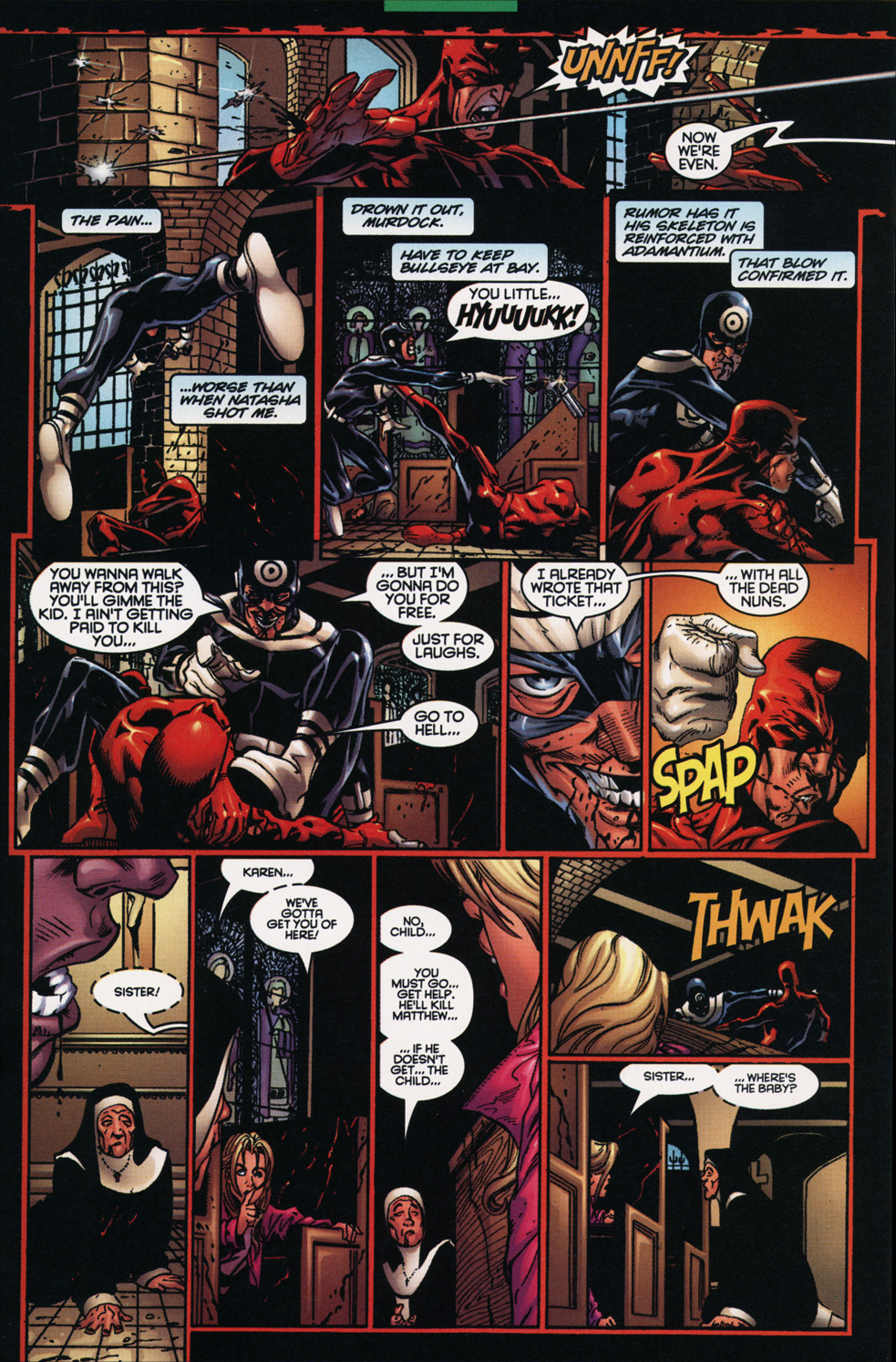
Daredevil Vol. 2.1 - Guardian Devil


My friend Adam highly recommended the entire series run of Daredevil, Volume 2. From my understanding, Volume 1 had run stagnant after thirty-four years and 380 comics. Marvel decided to reboot the Man without Fear and start afresh. Anon, Kevin Smith was hired to write the first story arc for the new series, Guardian Devil, beginning in 1998. Volume 2 ran for 119 issues, and concluded with a 13-issue mini-run titled Shadowlands

I'll be the first to say that my knowledge of Daredevil is very limited. Having read comics for most of my life, I've always considered the hero as a lesser compatriot of Marvel's bigger names: Spider-Man, Wolverine, Hulk, the Fantastic Four, the Avengers, and not to mention practically all of the X-Men. Daredevil just wasn't that interesting to me. Yet, on Adam's considerable recommendation (ending when he brought the entire run over to my house in a heavy, white box), I found myself with 131 comics to read. 

Matt Murdock is an attorney by day and a red-leather-tights-wearing superhero by night. He's blind. He's intelligent. He struggles with his faith. After a freak accident as a teenager, where he saved the life of a pedestrian from an oncoming truck laden with nuclear waste (it's always nuclear something something) and lost his eyesight, his remaining senses were all heightened to uncanny levels. 

The main plot of Guardian Devil revolves around an infant showing up in Murdock's law office. The mother drops the child off, claiming he's the Christ returned. Later, a mysterious man appears and tells Matt that the child is in fact the antichrist incarnate. Already conflicted, Murdock gets involved in a fight that spans from heaven to hell. Another important element to this arc was Murdock's relationship with his on-again, off-again flame Karen Page. 

Up front Adam told me the series started off kind of boring. He was right. The first eight issues held me captivated enough to press on, but suffered from some weak text and poor illustrations. Don't get me wrong. The art was just fine, but I was turned off by the peculiar choices Joe Quesada made, especially when it came to eyes*. Every time I looked at a person's eyes I was turned off. They looked almost childish. This just didn't work with the tone of the story Smith was telling (and I'm already not much of a Smith fan). 

Nevertheless, I press onward. So far Daredevil still sits in the shadows of my mind, but I'm anxious to see if he rises to prominence. If I'm judging based on Guardian Devil, I'd say no. But, for the life of me, I'll read this series if only to see what Adam's talking about.

*Generally.  Note Bullseye's eye in the panel image above.  It's swell.  This, however, is not the norm.