Friday, October 28, 2011

Dream Lover, a Review

One of the best things about blogging is the community.  From my experience, most of the bloggers I've "met" are all friendly, professional, and bloody brilliant.  It seems that everyone is erudite and capable.  It's fun vicariously exploring different talents through the blogs of others, whether it's as a stay-at-home mom or an emigrant living in a haunted house somewhere in Scotland.  You get all kinds of differences, and that's half of the beauty of the blogosphere.  

In particular, I've mentioned fellow blogger Mattson Tomlin a time or two here on Rememorandom.  The lad (I can say that, as he's four years my junior) attends SUNY Purchase for Film (according to his IMDB page), where he's finishing up his junior or senior year, I can't recall which.  Anyway, I've been following Mattson for a few years now, and watching his films and ideas develop on his blog has been a real treat.  His posts often seem like "behind the scene" special features on DVDs, and when you watch this stuff prior to watching a film, it gives one a completely different feeling.

Mattson used a Kickstarter project to fund the short film called Dream Lover.  I kicked a buck, willing to support someone else's dreams, and then followed the many status updates Mattson posted intermittently.  Then, to my surprise, I received an email yesterday telling me that Dream Lover was up and available to watch.  So last night I lounged on the chaise, turned off the lights, put in earphones, and let the movie take me away.


To attempt to describe what Dream Lover is would be, in essence, like asking you to describe your dreams.  While that may sound simple enough, then throw in the challenge of not only describing, but also conveying your thoughts and feelings during your dreams.  Explain the why, the how.  Heck, sometimes even the who and where is beyond words.  This is a glimpse of Tomlin's 16-minute short, and I feel like the director/writer has done well in capturing a dream.  It's ethereal.  It's bizarre.  It's ever-changing.  There's horror, sex, death, and many other commonalities of Dream.  Scenes are quick and fluid, and transitioning between them is handled with grace and feels natural.

All of that still does not describe what the film is about.  And here's the dilemma.  Like with anything worth value, there will be different interpretations, and Tomlin's Dream Lover is no different.  People are definitely going to react differently, to get different things out of it.  One may feel pity for Anderson, the lead actor (and played by the dapper Adam Griffith) who has either moved on in a relationship or not, while someone else may find him skeevy and calloused.  Then there's the spurned-and-devilish Selene (played by Maria Rowene), the other main POV.  Her development is as beautiful as it is frightening.  And the third main player is Hera (Jenna D'Angelo), though she's more of a secondary character.  Throw in the actual Greek myth of Selene and Endymion, and the film can take on a whole different meaning.  

The sound effects of Dream Lover are perfect.  They've definitely been loved on and tailored to each scene.  The camera shots are all very-well done (I particularly liked the wide-angle shot of Young Anderson hiding under the bench), and even the sex scene was done with skill.  The accompanying score at the end provided a haunting tune to close out the credits*, wrapping up a stirring little movie.

So the real question is what's to do now?  I could talk about my thoughts, my feelings, but I also don't want to cross into spoilery.  So instead I'll strongly recommend that you go to the Dream Lover site (here) and watch the film.  It's 16-minutes long, nothing too taxing.  It's free, too.  (If it asks for a password, use "sweetdreams."  And don't worry.  Mattson wants as many people to watch it as possible; it's password-protected because of film festivals or something.)  Furthermore, if you like it, be sure and let Mattson know, as well as any other people you'd care to share it with.  Dream Lover is a great exploratory film about dreams, love, loss, and many other things, and you'd be sore pressed to miss it.  It's also a perfect conclusion to this year's RIP, as horror is definitely present (a la monsters and confusion).

I believe in Mattson Tomlin.  I've watched everything he's made available, except for Pit.A.Pat, whatever that is, and I see him going places.  His vision is great.  His skills are tremendous.  His passion is obvious.  So here's to you, Mr. Tomlin.  Great work on Dream Lover.  Now, I can't wait to get to the feature film of Solomon Grundy...
-----

*Yep, my name is in the credits.  I'm assuming its the Kickstarter donors list.

Thursday, October 27, 2011

In Your Head, In Your Head, Zombie

[Note to the Reader: I recommend you clicking on the video first, letting it play while you read only if you've seen the video before.  Otherwise, I recommend on watching the video with the song.]

Oh man, this song wedges itself down in there deep, nestling right in between "Mana Mana" and "Do Wacka Do."  The Cranberries.  What a killer song, and a traumatic video, too, I daresay.  Plus, it's fitting for the season.  The video definitely captures the violent history of Ireland.


I love the viral lyrics, especially how Dolores O'Riordan sings them.  The heavy, steady bass-line pushes on continually, which is a metaphor all in itself.  As for the simple electric riff at the intro, solo, and outro, it's effective and lingers long after its finished.  And then there's the drums, beating and clashing, a perfect reminder of gunshot and clamor.  Yes, this song is monumental and powerful, but its also got a super catchy rhythm that definitely gets stuck "in your head, in your head."

I finally finished A Dance With Dragons, and now I'm debating whether or not to review it.  Is there a point to review Book Five of such an enormous series, where every word I say will be some type of spoiler for the previous four books?  No, probably not.  Dave is the only one who'd care.  In short, though, I enjoyed the book, just not as much as the first three.  Truly, it and AFFC could have been combined (as was the original plan) and condensed and the series would have been stronger for it.  As it stands, I'm slightly disappointed in the way ADWD ended.  Here's to hoping GRRM doesn't take as long with the next installment.

RIP VI is drawing to a close.  If you've not done so, go check out Carl's RIP Review site (here) and browse through the 600+ reviews.  I've put a few up myself, and should have one more before the thing winds to a close.  RIP is a great place to find new blogs, new books, and read some great reviews for the RIP season. Many thanks to Carl for continuing to host this event.

Avonlea's first Halloween aproacheth.  I shall endeavor to capture some memories with my memory capturing device.

Zombie. Zombie. Zombie-ie-ie-ie-ie-ooh-----

Tuesday, October 25, 2011

Nosferatu, a Review

Nosferatu is widely acclaimed for being one of the scariest films of all time.  With its iconic screen-shots, recognizable villain, lack of speech (i.e., a silent film), and word-of-mouth praise, I had some pre-conceived ideas about what to expect when I put the film on last night.  Sadly, my expectations fell flat within minutes of the film's exposition.  There are spoilers for those of you unfamiliar with Dracula or any other vampire story.


Nosferatu is essentially Dracula, though for legal reasons at the time, changes were made to avoid being sued.  Chiefly, Count Dracula is now Count Orlok, a creeper that lives off in the "land of ghosts and thieves."  A young real estate agent, and the film's protagonist, Hutter, has been given the task of securing deed work from Orlok to purchase a "beautiful and abandoned house" in the town.  Hutter leaves his beloved, Ellen, and sets off.  Needless to say, things go about how you'd expect, with only one additional plot element that I didn't see coming.

First off, before I begin deconstructing this film, an apology: I obviously am not the targeted audience and I've been too exposed to modern cinema to enjoy this movie.  Others (perhaps fans of TCM and Expressionism) like and appreciate this movie.  I don't.  And I'll explain why.

To begin with, I'm not a fan of Expressionism theater*.  I understand that it may have been useful for early 20th century folks, especially when so much was relied upon conveying through movement, but to me, it's just ridiculous.  I can't fathom why the folks of the time cared for it, either.  Real life is not Expressionistic.  The over-exaggerated movements and absurd facial expressions belong in a comedy, not a horror.  Most of the time I wanted to punch Hutter in the face for being so idiotic; I wanted to wipe the sycophantic smirk off of Knock's face; I wanted to slap some liberation into Ellen.  Even Count Orlok, while relatively reserved compared to the rest of the cast, fell to this form.  And as I said, this does not perpetuate horror, but comedy.

The next thing, and perhaps my biggest annoyance, was the score that accompanied the film.  We watched the Netflix Instant version of Nosferatu, and the film had a slide at the beginning that said the score was added in 1991.  I'm not sure who composed or played here**, or how this score compares to Hans Erdmann's original, but it was awful.  It basically sounded like a young musician learning about synthesizers and keyboards decided to tinker around.  Music rarely fit the scene, and half of it grew tedious after a few seconds of listening.

The third (and for brevity's sake, final) problem was the character's themselves.  Hutter was an idiot.  I don't know why he chose to act the way he did, but his actions were totally unforgivable.  Consider the following:
At Orlok's eerie and abandoned manse, Hutter is cutting him a slice of bread.  He cuts his finger accidentally.  Immediately Orlok is at the man's side and attempts to suck the blood from his finger.  Disturbed, Hutter backs away.  All the way to a cozy chair beside a fireplace.  Orlok, seconds later, suggests they sit and chat a while, and Hutter agrees.  The idiot falls asleep.  Then, the next day, he frolics around the estate, where he happens upon Orlok's sleeping body, that so happens to be in a coffin.  Horrified, Hutter runs away to the safest place possible: his room, where he puts a cover over his head and cowers in terror.  Good thing Orlok decided to leave for his new abandoned mansion, else I might have broken my tv.
What person is their right mind would do something like that?  It's so bad that I had to offset the whole paragraph!  Is Hutter supposed to be an imbecile?  And another thing.  Hutter brings a few books with him to read.  They're necessary plot devices, and when he picks one up, a slide comes up to show the Viewer what he's reading.  At one point, Hutter finishes his book and he slams it shut then hurls it to the floor.  For no apparent reason other than to persuade the Viewer that that's how one ought to treat a book.

I could go on and on about my problems with the film, but I'll stop at three.  There is a few commendable features, chiefly Orlok himself, that I found slightly enjoyable and somewhat creepy.  Max Schreck played his part well, and the vampire's movements & actions were the only part of this movie that could qualify as horror.  I particularly liked his slow walk and his disfigured face.  


In the end, Nosferatu was a worthless movie to watch.  Perhaps had I watched it fifty years ago.  Perhaps had I muted the tv.  Perhaps had I gouged my eyes out.  But alas, I did watch it, and I can't really recommend it to you unless you're a silent film fan, or simply curious to see the seminal vampire movie.  That said, there are other versions besides the one on Netflix, and mayhap they're better.  I won't be investigating, though.
---------------

*Though it does often work well in a comedy.

**A Google search says there are two Netflix versions.  One has a score created by the Silent Orchestra, which I believe is the one I watched.  The other apparently is no better.  [Source: here.]

Friday, October 21, 2011

Flash Fiction Friday: Medical Log Entry #16

Medical Log Entry #16
Patient: John Doe

You would think that in the midst of certain Armageddon--global thermonuclear war, devastating pandemic, cybernetic revolution, and the African continental plate disappearing, to name a few--that one would be accustomed to expecting the unexpected. I, for one, am no stranger to the bizarre. After my stint in deep space, my mind’s been programmed to think well outside the bounds of normalcy. Add that to the thirty-one years with the Force, I’ve seen it all. But when Nilo called me up and told me I had to hurry home, that I just had to see this, I could tell from the tone of her voice that something unique was waiting for me.

Nilo and I first met at UMBRA back in 0-13. I was newblood, straight from the uni’s proud and ancient halls. Still had the naive shine in my eyes. Still thought the earth tilted at twenty-three degrees. Nilo was already an old hound by the time I showed up. She’d been immersed in the strange for half a millennium. Everybody who’s anybody knows who Nilo the Cyrene is. Her fame is known from here to the outer sectors. She practically wrote the book on modern criminal psychology, as well as how to deal with the ramifications.

Needless to say, I boarded the next transport home. Of course, home was currently over two hundred and forty-nine million miles away, past Mars, past what’s left of Moon, back in tiny little Harrison, Michigan, United States, Earth. Traveling near Mach 100, the trip would take over a third of a standard year. That’s a long time for someone to wait, I had told Nilo, but she assured me I would be fine as long as I left soon.

It was day eighteen when it happened. Our transport was careening at speeds approaching oblivion (though nowhere near the higher realm of the mighty c), but inside the Argo everything was relatively calm. I excused myself from a fascinating conversation about fungus with the delightful Dr. Dame Wolffa and made a bee-line for the privy. It was there, standing in front of the mirror and watching the recycled greywater gush from the faucet, that the Argo experienced turbulence. I staggered. My head hit the counter top. Something massive crashed into the transport and the entire world around me shook violently. I heard a few gasps from outside, but the door on the privy was sealed shut and refused to open. I banged, as if expecting that to do anything, and again the world shook. It was as if an earthquake was loosed upon us, though, as I said, we were many million miles away from Earth.

The interior lights cut off, plunging me into sudden darkness. A moment later the emergency lights flashed on, a bright orange EXIT sign illuminating above the door. “Not hardly,” I said, pulling again at the latch. Open sobbing now sounded from without. I heard prayers and pleadings. Then the shuttle shook again and something massive crashed into it, grinding it and everything within it into dust.

Everything turned into colors. Sounds. Tastes. Smells. Indigo from a rainbow. The shade of dead wheat.  Mist from a waterfall.  The brightness of Sun at daybreak. How keystrokes sound at high WPM. Iris milky white. Bland oatmeal on a summer’s luncheon. Nilo’s perfume the night we went to Cloisters. The saffron hue of her lipstick. Darkness, encircling and pulsing, my body spinning in a billion little pieces, each turning and rushing along with whatever carried it away. An old dirge of trumpets and cellos. The grey of sepulchers and the gold of crowns. Salt on springmelons. Her laughter at the cine. Her hand inside mine. Dark blood red after a gunshot. Sand grains beneath fingers within cake upon grass under covers pork insulafoam bone masks joy inside you ache love numbers algorithms infinitely complex knowing knowledge knowing nothing spinning spiraling spewing splicing splaying splintering fragmentslightblackhopelostfoundyou...

Life coalesced; meaning reared its head; every road I’ve ever traveled was before me; every choice I’ve ever made; every possibility of everything, past, present, future. I was dead, and I wasn’t. There was still work to be done. Something remaining for me. All of this and more I knew, as if the Almighty chose to give me a glimpse into His mind. There was terror and there was certainty. Above all there was love.

I awoke here at St. John’s Hospital. I’ve no idea of the date. Every time I ask I’m told something about something called “January,” whatever that means. The orderlies all shun me. I see hate in their eyes. Distrust. There is one I may be able to persuade to join me, for I see sympathy in him. Still, I am lost without my Nilo. No one claims to know her, and I’m beginning to question her existence myself. I am no longer confident of anything. They asked me to write this all down, and looking back at it I can’t discern fact from fiction. They are trying to help me, so they say, but to me it’s more like an interrogation. Nothing makes sense. I am confined but for my writing arm and my neck. So I write, day in, day out, hoping someday that I can look back over this and find the truth. I know it exists. I had it in my grasp as I rode the comet back to Earth. But eternal fire is not meant for human minds, and I now must pay the cost. One day I will recover, and when I do, I will flee from this place and find Nilo. Until then, I must have patience.
-----

Word Count: 938
-Written as an exercise in futility, plus, it's been a while.

Wednesday, October 19, 2011

Reconnaissance

Monday morning.  5:15am.  Cool.  Sleepy.  I go through the motions of my daily waking ritual, only now an hour earlier.  I take up my travel gear, kiss the sleeping ones, and hit the road.  Coffee, black, two creams, loathsome from McDonalds but open and cheap.  I pull into the office at 5:50, unload and re-load into Mike's. We're on the road by ten after six.

---

The trip is shy of four hours.  We drive in early morning bleariness.  Traffic is dead.  I may as well be.  We hit a rest stop halfway to our destination.  Temperature's dropped.  I see my breath in the air.  The road rumbles on as we roll west, away from my family, my home, and everybody I love.  It is the first time I've left my daughter for this long, and I miss her already.  But there's work to be had.  We're explorers bound for a brave new world, or at least a different world than home.  The Arch appears in the smoggy distance.  East St. Louis, we have arrived.

---

I am no stranger to urban life.  For five years I lived in Louisville, a relative metropolitan with a population in the millions.  I had a few different residencies, one being in a house dubbed the Old Skank.  The heat barely worked.  Water was so hard that it was almost white coming out of the faucet.  The cabinets were tilted and doors would close/open as per gravity's whims.  To get in the tub you had to step over a two-foot wall.  My car was broken into here.  An attempted rape was stopped on the front porch just houses away.  Yes, I know the seedy parts of the city, but all of this had nothing on our corner of heaven in East St. Louis.  Windows and doors were barred; scores of houses were condemned; everything was in disrepair.  But we weren't house hunting; no, we were looking at drainage structures, trying to see how the water was flowing in and around the intersection for our new project.

The stretch of road isn't very far, just a simple interchange with a bridge.  There were around 30 culverts to inspect.  To do this, we found these structures on our maps, then took pictures of them.  If anything of special interest caught our eyes, we'd jot notes down, though this usually consisted of whether or not an inlet was grated and/or clogged.  Occasionally we'd find some crazy outlet conditions, and one culvert took us several hundred feet into a mysterious woods filled with eroded banks and lethal briars.  Ah, but it was nice to be outside, and Monday proved warm enough to need only short sleeves.

We worked hard, and by six o'clock, we were both tired.  The hotel called; supper beckoned; sleep scratched.  We relented.  I brought my computer, aiming to get in some good writing time.  I brought some books, eager to read.  Alas, I was too sleepy.  By ten-thirty I was out, missing Avonlea, missing Keisha, missing Kentucky.

---

I had a nightmare, for the first time in ages.  I woke up at 4:40 with goosebumps.  Someone was standing over me.  I dreamed of demons, but I know not why.

---

6:30am.  41 degrees.  Raining.  I'd slept with the air conditioner on, so my room was icy.  I hurried and dressed, packed, and headed down to see how awesome the breakfast would be.  There was a waffle maker, so it was at least palatable.  We ate breakfast and went over the plans while reruns of Charmed played across the screens above.  There were a few more culverts to inspect, and since it had been storming, we'd look for some of the pipes we couldn't locate the previous day.

We worked through the rain, and by lunch my feet were thoroughly soaked.  Tennis shoes were a bad idea, but I have no boots other than steel toes.  Wet, cold, and hungry, we finished our reconnaissance.  For lunch, Cracker Barrel had the fireplace lit.  I changed clothes and cozied up to the flames.  A hearty meatloaf later, we were on the road, returning home.  Four hours later, the car was emptied, Rosebud was re-loaded, and I was home.

The collected data will be useful, as I'm starting on a new project.  Basically the site visit makes our 2-d maps much more useful, especially now that I have an idea of how the water will flow after a rain event.  When drawing drainage areas for watersheds, the USGS quad sheets are generally helpful, but aerials and real-world shots sometimes give a different result.  Next comes the actual drainage analysis, the studying of ditch flows and culvert discharges.  Should be interesting to see this go from start to finish.

Friday, October 14, 2011

A Night of Blacker Darkness, a Review

"Do you ever wonder," said John idly, "why we call buildings 'buildings?' Are they in a state of constant construction? We should call them 'builts.'"
--- 
"Not like that," said John. "More tuneless, almost melancholy--like the whisper of a dying candle."
"I think it's safe to say that no one in this room knows what you're talking about."

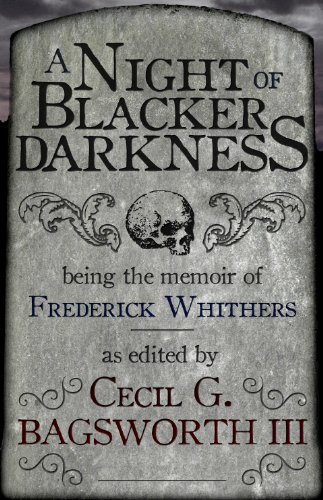
A Night of Blacker Darkness, being the memoir of Frederick Whithers, is exactly what the subtitle says it is: a memoir.  Who, you may ask, is Frederick Whithers?  Mr. Whithers was a simple man of the early 19th century, who lived quite a simple life prior to his death, at least according to Mr. Bagsworth III's introduction.  According to official records, Whithers died of consumption while serving a prison sentence for forgery.  But if the memoir is to be believed, he faked his death, rose from his coffin, was spotted by a group of vampires who immediately proclaimed him the Great One, and had an unusual few days of pure  farcical madness as he tried to lay stakes on a ninety-thousand pound inheritance.

To expound on this madness would, I fear, spoil the brilliance of Mr. Whithers' memoir.  There is a great mystery lurking in the plot, drizzled with some fantastic humor so thick that one's willingness to suspend disbelief is almost challenged.  Murphy's Law prevails often, it seems.  The story is hilarious, and I had to stop reading a few times just so I could finish laughing.  John ____* may be one of the funniest characters I've ever read, and his dialogue/musings always cracked me up.

I became aware of A Night of Blacker Darkness just a few weeks ago.  While browsing Kindle book deals, I was looking through favorite authors, and this book came up.  And being a fan of Dan Wells, the mastermind behind this fictitious memoir, and furthermore intrigued because this book is only available as an e-book, I decided to give it a go.  I assure you, it's well worth the $5.

So what more can I say about this book?  It's very well written, though there are a few errors throughout the pages, but not enough to derail the story.  It's definitely macabre, as Frederick's post-prison journey takes him to graveyards, mortuaries, charnel houses, a ghoul's lair, a basement full of vampires, and many other random places throughout Bath and London.  And while the story never crosses into all-out horror, there are traditional elements of horror present.  To me, though, the delight came from the mystery mixing with the antics.  Wells makes use of a few familiar tropes and creates a gem.

I could say much on this read, but so as to not potentially ruin anything, I'll say little else.  If you have an e-reader, you really should read this book.  It's short and can be read in a lazy afternoon.  It'll have you laughing and have you intrigued.  I can easily recommend it to genre fans, literary fans, people that like to laugh, people with e-readers, and fans of Young Frankenstein or Dracula Dead and Loving It.  Better yet, go to Amazon and read the free sample (here).  I heartily enjoyed A Night of Blacker Darkness, and I eagerly look forward to seeing what else Dan Wells has to offer.
-----------

*This surname is intentionally blanked out by me, not in the book.  

Wednesday, October 12, 2011

General Updates


i see your bet and i raise you fifty more.
It's hard to believe that Avonlea is now over four months old.  She had her appointment for shots and stuff on Monday, and it possibly was the most heartbreaking thing I've ever seen.  The first round of shots from last month had nothing on this batch.  After a general check up from the pediatrician, the nurse came in to give the immunizations.  The first shot went in, Avonlea went from happy to total betrayal shock then to momentary silence to all-out screams in two seconds.  Then came the second shot in the other leg and the poor baby somehow became even more pitiful.  I really thought I was going to cry.  There's something about that defenseless mewling that destroyed a small part of my soul, but I know it's for her good.

Prior to all of this, she was weighed and measured.  Avonlea now weighs 9 lb, 6 oz, which puts her in the <5% on weight for babies her age.  This is congruent with her 3 month weight, as well as birth.  Length she is now in the <10%, so that's some improvement from the previous two measurements.  Foreverthemore, the good doctor said she looks great, acts great, and is perfectly healthy.

We're expecting her to start picking up some weight, since we began supplementing her with actual baby food a week or two ago.  Avonlea, like her daddy, loves green peas, though she's a touch messier than I am when she eats them.  She's not overly fond of bananas, but carrots are proving delicious.  The brown rice cereal is neither here nor there, but it's definitely filling, as evidenced by her sleeping through the night.

Sunday also turned out to be a wonderful day.  I lazied on the couch all afternoon, watching the Colts screw up and lose, and Avonlea lay right there with me.  This is a milestone, as Avonlea generally does not enjoy napping  by daddy and usually begins crying almost instantly.  (Oddly enough, she loves me rocking her to sleep and curls right up in my arms and drifts off pretty quickly.)  Still, she fell asleep on my chest and it was perfect.

Saturday night was The Well.  It was our first gathering.  A group of us really just want to get deeper in our relationship with God, deeper in our worship, in our praise to Him, and more in touch with our brothers & sisters.  We sang some songs, studied some Scripture, and glorified God in our quest to breathe His Word.  It was refreshing and intentions were met.
at mom's house.
I've also been working on a short story that I plan on putting out here as a Writing Wednesday post.  I have another one finished (though unedited) that is part of something much larger, something that's been in the works for a while now.  NaNoWriMo is next month, and while that's the perfect catalyst to force me to spew some words and thoughts, it's also too hectic an event for me to commit to, especially now that we have Avonlea.  I wish we had some sort of writer's group here in OBKY, or just some sort of pen pal like person that I could bounce ideas off and get my stuff ripped to shreds.

I'm finally starting on a new project at work.  After two years of tweaking a project down at the Land Between the Lakes, it's nice to finally be staring at something new.  What's more, this project is located in Illinois, relatively near St. Louis.  Because of it being in a different state, there's a whole new set of guidelines to follow for design work that's different from Kentucky.  While interesting and insightful, it's also tedious.  Soon, though, I'll be into the work and eager to start.

Lot's going on.  Maybe a book review Friday, and if not, then probably Monday.

Thursday, October 06, 2011

In Cold Blood, a Review

Holcomb, Kan., Nov. 15 [1959] (UPI) -- A wealthy wheat farmer, his wife and their two young children were found shot to death today in their home. They had been killed by shotgun blasts at close range after being bound and gagged ... There were no signs of a struggle, and nothing had been stolen. The telephone lines had been cut.—The New York Times

I'm hesitant to review Truman Capote's seminal true-crime novel In Cold Blood.  How does one begin to review non-fiction, let alone true stories?  I see the vanity of my opinion on the situation and want to run screaming the other way.  But that curious part of me, that part buried in a metal box in the middle of my heart, twitches and pines for things it ought not.  As I've mused time and again, I am inexplicably drawn to these things.

In Cold Blood is the account of the Clutter murders.  The book is broken up into four sections and told through numerous Points-of-View.  We watch Herb Clutter, kindly and genteel, make his way around Holcomb, conducting business for his family farm.  We see sixteen-year-old Nancy Clutter's budding relationship with her high school boyfriend.  We struggle with Mrs. Clutter and her bouts of depression, and son Kenyon (15) and his aspirations.  We're told about the small town of Holcomb and its caring citizens, where Church is society, the diner is always busy, and idle talk spreads fast.

Beyond this, and the more intriguing parts of the book, we travel with Dick Hickock and Perry Smith, two parolees who ultimately murder four innocent people for the hope of a chance that Mr. Clutter kept a safe in his house, filled with at least ten thousand dollars.  We learn of each man's upbringing, of their choices that landed them in jail, of their plans and goals, of their bitterness, and of their deaths.  It's easy to pity them, to wish things better for them, but from the onset we're aware of their deed and their execution.

Capote is brilliant in building dread and suspense.  Scenes change quickly, and since this is a journalistic approach, we see various sides of people/events.  There is much to be said about the crime, the victims, the criminals, and the aftermath, and Capote adroitly handles it all.

Strikingly, the brutality of the crime (as well as the executions of Hickock, Smith, and some other men on Death Row) is done in a matter-of-fact way.  Capote presents the scene with little fanfare, and this minimalism is chilling.  The Reader is left as dazed and confused as the townsfolk of Holcomb were, and one can't help but press on to discover the true motive.  Why? continually comes to mind.  Emotion is poured into the book, though often it is reserved and professional, and this dichotomy makes for an oddly disturbing read.

In Cold Blood has been on my TBR shelf for a very long time, and I'm glad it's finally gone.  I wanted to read it for RIP this year because this stuff is what truly defines horror to me.  It's real and 100% possible, not like some phantom killer or haunted house.  I tend to think that we've created ghost stories as an escape, preferring the supernatural to the perfectly natural.  Because there are killers out there.  People that torture, kidnap, rape, murder, assault, harass, antagonize.  And who knows when someone could simply snap and massacre a shopping center or bookstore?  It's scary enough to make me want to take my family and live in a bomb shelter, buried and out of sight, safe and secure.  And when my mind starts roaming these uncomfortable corridors, I have to ask myself one question: what if you're the one to snap?

And it stops me.  Cold.  Because I'm human, just like Dick Hickock, Perry Smith, Herb Clutter, and everybody else.  I'm no killer, but I could be.  We all could be.  We all have the potential.  What keeps us held back is our self-control, or maybe our fear of prison and death.  What keeps me back is my love for people, my love of life, made possible by the gospel of Jesus Christ.  Without Him, I think I'd be some kind of messed up person, but I trust Him and His word that He'll never leave me or forsake me.  But really, when you think about it, if you stand two people side-by-side, one a killer, the other not, and put them in identical clothes and ask someone to pick out the killer, there's no difference.  Both are just simply people, and that's the most terrifying thing out there.  We don't really know anyone...


[Note: After re-reading this, I realize how disturbing this post is, and I've considered simply deleting and starting over.  But, as a purist, I find that path treacherous.  Instead, I'll echo my previous line.  I am enslaved to God and committed until I die, therefore I do not keep myself restrained from going out and murdering somebody.  Instead, I deal with the more insidious sins, things like when Jesus said that being angry with your brother was basically wanting to kill him, and inward lust was the same thing as adultery, and pride--oh how I loathe thee!--that snakes its way into every aspect of my life.  Yes, friends, I am perfectly sane (to my knowledge).  Just trying to make my way in the world the same as the rest of ya.]

Friday, September 30, 2011

Scary Stories to Tell in the Dark, a Review


Perhaps the reason I've an affinity for dark & twisted art lies with a trio of books I read as a child.  Alvin Schwartz is most known for his collection of folktales marketed towards children.  His most famous books--Scary Stories to Tell in the Dark, More Scary Stories to Tell in the Dark, and Scary Stories 3: More Tales to Chill Your Bones--were some of my most favorite reads as a lad, and when I recently happened upon my personal copy of SS3, I couldn't help but dive in.  I went to the library and checked out the first two volumes (not sure why I only have the third?), then promptly drove home and leafed through the pages.

It's impossible to continue without acknowledging Stephen Gammell's defining artwork.  In fact, I'm going out on a limb and saying that it's Gammell's work that makes this collection so cherished (and challenged*, for that matter).  I love the loose, spindly, flowy lines that add an ethereal feel to each work.  Everything has the tone of something horrific waiting to be loosed upon your mind.  I would love to see Gammell do some Lovecraftian illustrations.  Yes, it is Gammell's work that shines in these books, and they've no doubt affected my subconscious.  

Allow me to wax on here.  The illustrations are grotesque.  Magnetic, whereby they repulse the reader, but attract as well.  I feel as if Gammell has somehow captured the essence of a nightmare (or some hell) and then rendered it on us, and, in particular, young minds.  Frankly I'm surprised these books are read by kids, as I can easily see them getting utterly creeped out and running for Mommy in the dead hours after midnight.  Moreover, as I was rocking Avonlea to sleep the other night, I was reading the books and left them beside her crib after she went to sleep.  Keisha brought them to me later as I was brushing my teeth and said, "You can't leave those in there. If I look over there and see 'em in the middle of the night I'd be freaked out."

I guess I would, too.  I have this fleeting fear whenever I wake up during the night.  With the thick shadows and eerie softglow lights, coupled with the fact that I'm not wearing my spectacles, everything is blurred and skewed.  My mind deceives me.  My eyes tell untruths and distortions.  I see monsters and things unknown in the darkness, sinister and evil, things that would fit perfectly alongside these horrors Gammell's illustrated.

Still, there is more to these books than just the art.  Schwartz writes in an easy to understand form, especially for children.  To my understanding, the intention is for these things to be read aloud, and working with that assumption, these stories all do well.  However, if one looks too closely as the sentences, well, one gets disappointed in the simplicity.  It's anticlimactic at times, coming across as uninspired and flat out boring.  This is not prevalent, nor is it epidemic, but the way these stories are told is very weak when compared with other folktales.  (This seems fickle, as I'm comparing a children's book to adult, scholarly things, but what can I say?)  Nevertheless, I did feel like Schwartz dropped the ball several times throughout these three books, but if you're reading them aloud, it's not too bad.

If we look at the folktales and urban legends themselves, then these three books are a treasure chest of them.  Each tale spans from 1-3 pages (most falling at just over a page) in length, and because of that, there are a multitude of stories.  Many are familiar things, things we all know, things our grandparents swear are true.  But there are more than enough unfamiliar ones, too.  And to me, digesting a "new" folktale, especially one that's been around for years, is like cream cheese icing on a carrot cake.  Delicious.

I appreciate Schwartz listing a bibliography at the end of each book, as it's nice to be able to dig deeper (or see different tellings) for a story.  When things are from oral tradition, Schwartz lists people involved, too, or areas he collected from.  I also like how there are "alternate endings" or miscellany for the stories listed.

These three books are delightful little reads.  There's no doubt that they're heavily responsible for my taking to folktales, as I read these books for the first time in elementary school, but they're also probably responsible for my weakness for dark art.  I'm glad to have stumbled on my copy of SS3 the other day, and even more glad to find the library's copies were in the stacks and not checked out.  Halloween is the perfect time to read these books, and the RIP challenge just makes it more pleasant.  If you've never read the stories Schwartz tells, then you're missing out.  But even more, if you've not had your heart stopped by Stephen Gammell's horrid illustrations, you're really missing out.  I strongly recommend remedying this as soon as humanly possible.


-----
*Not only was this series the most challenged during the 1990s, it was also the 7th most challenged between 2000-2009.  I'm assuming 

Wednesday, September 28, 2011

Don't Check Your Brains at the Door, a Review


Josh McDowell, like C.S. Lewis and Lee Strobel, had a problem with Christianity. As an agnostic, he set out writing a paper to disprove the Christian faith, which ultimately led to his inability to do so and his surrender to Christ. A renown apologist, McDowell, along with Bob Hostetler, produced a simple book of common questions for young Christians, a book titled Don't Check Your Brains at the Door. Originally released in 1992, I recently received an updated edition for a more modernized society.

Don't Check Your Brains is targeted for teens and young adults. The book is conversational and the tone is light and humorous, but it never loses its focus. Divided into six sections, the book covers myths about God, Jesus, the Bible, the Resurrection, Religion and Christianity, and Life & Happiness. There are forty-two 3-4 page chapters, and each chapter ends with a "Brain Food" application. The "Brain Food" stuff includes readings from the Bible and insights for practical living.

As an older Christian, and having read some more theological denser material (like Strobel's A Case for Christ), I wasn't blown away by anything I read. This, however, was not my intention in reading the book. I volunteer with the youth at church and I wanted to read it to see how I thought it would help high schoolers and middle schoolers. To this age group, as well as fledgling Christians, I think Don't Check Your Brains is a fantastic resource. It answers tough questions with Scripture, as well as establishes a seed to grow deeper in understanding God's Word.

I think this book is a great starting point for those that are clueless about their faith and why we believe things we believe. Many great questions/myths are addressed, such as New Age Thoughts, Wimpy Jesus, and God Grades on a Curve. These are but a few examples, and I think many of these myths will be encountered by the upcoming generations. In the end, Don't Check Your Brains at the Door is a simple and engaging book that should hold the attention of a younger audience, but also impart truth and evidence for common questions they may face. The book would fit perfectly with young and curious minds, and may just spark some thought in older ones as well.
-----------------

*FTC Thingy: This book was provided for free as an ebook download from Thomas Nelson Publishers and Booksneeze.com.

Monday, September 26, 2011

House of Leaves, a Review (Spoiler-Free)

Little solace comes
to those who grieve
when thoughts keep drifting
as walls keep shifting
and this great blue world of ours
seems a house of leaves

moments before the wind. (p.563)"


Defining Mark Z. Danielewski's House of Leaves is like asking a five year old to describe the Riemann Hypothesis.  House of Leaves is, on its fringes, a story about the Reader.  In the Introduction by Johnny Truant, we're flat out told that what we're reading is a product from a manuscript he found in the room of a dead man named Zampanò.  The manuscript, as it turns out, is a scholarly work based on a documentary Zampanò has become obsessed with: The Navidson Record.  And if House of Leaves is about anything at all--its heart, its cornerstone, its foundation--then it's about The Navidson Record.

Will Navidson is a critically acclaimed photojournalist.  Years of life spent away from his long-time partner Karen Green, a former cover model, and his two children, Chad and Daisy, has the Navidson family barreling towards non-existence.  Will and Karen decide to purchase a quaint Virginia house and settle down and work on their family.  Will seeks to finish his career with a simple documentary on their new lives in their new home.  He installs video cameras throughout the house, motion sensors to pick up when activity is going on, and settles in for a calm retirement.

But everything does not go as planned.  The house seems odd, and one day, for no apparent reason, Will and Karen discover a new closet situated outside their bedroom door.  Baffled, Will gets the floor plans and begins going through measurements, confused.  And when he discovers that the house measures larger on the inside than it does on the outside, the groundwork is laid for the rest of the "movie."

The Navidson Record is as tantalizing as it is terrifying.  The house on Ash Tree Lane is creepy and dark.  Navidson, an explorer at heart, sets out to understand the house and its unnerving black (and apparently unending) labyrinth of hallways that appears in its center.

Zampanò's manuscript exhaustively covers the film, from its subtle and serene beginnings to its haunting and stunning conclusion.  His work is littered with footnotes, and as Truant tells us at the onset, many of these footnotes' references simply do not exist in real life.  Keeping this in mind, the remainder of the manuscript makes for a fascinating exploration of the film, sometimes mind-numbingly so.
"As I discovered, there were reams and reams of it. Endless snarls of words, sometimes twisting into meaning, sometimes into nothing at all, frequently breaking apart, always branching off into other pieces I'd come across later--on old napkins, the tattered edges of an envelope, once even on the back of a postage stamp; everything and anything but empty; each fragment completely covered with the creep of years and years of ink pronouncements; layered, crossed out, amended; handwritten, typed; legible, illegible; impenetrable, lucid; torn, stained, scotch taped; some bits crisp and clean, others faded, burnt or folded and refolded so many times the creases have obliterated whole passages of god knows what--sense? truth? deceit? a legacy of prophecy or lunacy or nothing of the kind?, and in the end achieving, designating, describing, recreating--find your own words; I have no more; or plenty more but why? and all to tell--what?" (p.xvii)
But still yet, in an even further removed frame, the Reader understands (again, at the beginning of the novel, so as to keep SPOILER-FREE) that we're also reading Johnny Truant's annotations of Zampanò's manuscript.  Truant's story begins in the Introduction, and as it unfolds throughout the footnotes, we discover how the manuscript affects him.  Truant is a mesmerizing POV, as one of the first things he tells us is that he's unreliable.  And as we read, both the manuscript and the footnotes, we're constantly left puzzling over what's been altered, if anything.  This, as the Reader will undoubtedly understand, is disorienting and intentional.  And as we come to understand Truant's background, especially concerning the Whalestoe Letters, what's real and what's not comes under even more scrutiny.

To me, the most interesting part of the book deals with the darkness inside the house.  Danielewski a la Truant a la Zampanò paint a vivid picture of the blackness, the absence of light within the house.  
"The walls are endlessly bare. Nothing hangs on them, nothing defines them. They are without texture. Even to the keenest eye or most sentient fingertip, they remain unreadable. You will never find a mark there. No trace survives. The walls obliterate everything. They are permanently absolved of all record. Oblique, forever obscure and unwritten. Behold the perfect pantheon of absence." (p.423)
I know what dark is.  I live in the state with the largest cave system in the world.  I've been to the depths of the earth and had the lights extinguished, propelled into absolute darkness, a blackness so thick that one can't help but despair.  And yet, the darkness within the house seems darker.  This has definitely played upon my mind at night as I've roamed the halls of my own house, and I confess to a quickened pulse a time or two.

Another part that must be addressed is the bizarre formats used.  This was the primary reason I wanted to read the book, and after finishing, I enjoyed the way the book was presented.  The Reader has to flip the book, turn it sideways, and go through mental hoops to read certain passages, but it definitely adds to the story.  I read the full color edition, which is the author's preferred edition, as it includes over two-hundred pages of appendices, filled with more fascinating puzzle pieces (and if you read the book, I recommend following the instructions to see the Appendix before continuing on with the novel) and I can't imagine reading this book any other way.


So what is House of Leaves?  It's a book containing four stories, one woven story, some spelled out more than others, some flat out ignored.  It's meta.  It's contained.  It's puzzling.  It's erudite, so keep a dictionary very close.  It's compelling.  It's tedious.  It induces smiles and wicked grins, but groans and sighs.  It's beautiful.  It's art.  It's a love story.  It's disgusting and leaves one needing a bath.  It's definitely not for the faint of heart or those offended by crude sex.  It is a remarkable read, leaving the Reader satisfied and immediately ready to dive back in again to see what's missed, but at the same time worn down and betrayed.  If Danielewski intended this, then he succeeded.  I enjoyed House of Leaves immensely and would love to discuss it with someone (thankfully there are forums devoted to it).  It's easy to recommend.

Tuesday, September 20, 2011

Disciple, a Review


I selected Bill Clem's Disciple: Getting Your Identity from Jesus because I thought the book was about discipleship groups, mentors/mentees, etc. and practical applications for modern life. Instead, I found myself reading a book about what it means to be a Christian for the first 3/4 of the book. I almost get the feeling that Clem would prefer to use the word Disciple instead of Christian, though that is pure speculation. Nevertheless, Disciple proved to be a mostly interesting and thought provoking book. 

Divided into 12 chapters, the book alternates between the biblical ideal of the chapter's topic (such as Community), followed by a chapter with how we've distorted it. I really enjoyed the layout like this, and as I progressed through the book it was obvious how much latter chapters built off the previous ones. I also liked that each chapter ended with a "homework assignment." Clem gives the reader Scripture to read and ponder over, and often challenges us to act on these verses. 

As for the last chapters, this is really where practical thoughts on discipleship came up. I suppose a foundation must first be established before application can be described, and Clem definitely built off his groundwork. 

The art of discipleship and mentoring is neglected by many today. Too often we distort the very definition of "disciple," thinking that it's a stagnant "relationship." We replace Jesus' Great Commission in Matthew 28, "Go and make disciples" with "Go and make converts." It's obvious Clem has a heart for loving on people and investing in them, and he backs this imperative with plenty of Scripture. He wants the reader to make disciples (as well as be discipled), not coverts. 

All in all, I enjoyed a lot of what Bill Clem was saying in Disciple, and I think it would be especially helpful for young Christians. The first majority of the book reads as a sort of "Christian Essentials" text. I was more interested in the latter half, and indeed Clem has some worthwhile things to say there, though I wish this part were longer.

Friday, September 16, 2011

Radioactive Aardvark Nationality Domesticated Onslaught Metaphysical

Are you hungry? Are you sick? Are you begging for some bread? She lived with a broken man, a cracked polystyrene man.  I'm a creep.  Apparently it's called ergodic literature, and I kind of dig it, but at the same it's rather exasperating.  Maybe not exasperating.  Maybe tedious.  And sometimes it makes for a Day of Interest if you're up for it.  But sometimes I'm not feeling it, and I'm left following the sentence as it winds its way across pages, over commas and semi-colons, but never a period, and I get lost somewhere along the way.  Maybe you will, too.

Anthropomorphism, start!

She wasn't dead, but she was terminal.  Stop whispering!  She concocted a disease, a rather nasty one, that left her essentially brain dead.  Stop shouting!  At first I held out hope that she would recover, but she didn't, not even after she was supposedly healed.  She crawled, yes, and ticked idly, but she stopped responding and turned blue then black then the lights just winked out and I left her for dead.  I stole everything I could from her carcass, thanked her for being good, and then I went Kevorkian.  I'm a wicked child.

Anthropomorphism stop!

First degree murder is premeditated and planned and done willfully.  Second degree murder is not planned in advance.  Voluntary manslaughter is murder by accident, maybe, possibly, if your lawyer's good enough or you're sincere enough.  Involuntary manslaughter is purely unintentional.  Do not cry out or hit the alarm, you know we're friends 'til we die.  Suicide is self-murder, and can be rendered first degree, second, or manslaughter.  Either way you turn, I'll be there.  Open up your skull, I'll be there.

.wen sa doog sa (ylraen) s'ehs won dna ,yriaf doog a fo ecnatsissa eht htiw efil ot kcab thguorb saw ehS

See what I'm saying?  It's tedious, but once you throw in a mystery, a monster, a thing, a hope, a promise, a chance, a sanatorium, a disaster, an eleven-year old, a foray into foreign language, then you start seeing that there is a purpose to it all, that the ergos one does to understand is intentional and disorienting and disemboweling (okay, I just made up that last bit), and the format is important, as much as a format can be.

As per Demitri Martin, saying I'm sorry and I apologize is pretty much the same thing.  Unless you're at a funeral.  I love the cold snap.  I actually had to close the window last night and throw a quilt over us.  Even the curs were lazy from the cold.  Not-so-subtle-but-profoundly-strong-suggestion: Go to Tor.com (here) and read Kij Johnson's astonishing ultra-short story (like it's totally less than a thousand words, probably more like 500[edit: according to MSWord it's 1,254 {that's MCCLIV to any of you Ancient Romans that are roaming the Nets here, or wayward seventh graders for that matter}]) called "Ponies."  Sit down.  Stand up.  Like, zomg that story was so gooood, and it's so fitting for the RIP challenge, and I really think you should read it and tell me what you think about it.  Reckoner, take me with you.

Life rolls like a Bob Dylan, o'er choppy seas and serene lakes.  All around me winds blow hard, but I myself am fine.  It sucks seeing others maltreated.  Anyone can play guitar.  (Nice Dream)  So I saw that Stephen King is releasing another Dark Tower book, this one called The Wind Through the Keyhole and set between Wizard and Glass and Wolves of the Calla.  I can't decide how I feel about this one.  Mostly indifference.  I quite enjoyed that series, but at the same time it was also lacking in parts, especially there as the ka-tet drew near the Tower.  Oy was one of my favorite characters.  Myxomatosis.  I may return to Mid-World, and I mayn't.

Anthropomorphism spoiler!
(It was the computer.  Being dead and now quickened.)

I'm the kind of person that pretty much always sits on my left leg whenever I fold one up beneath my bottom to sit.  For that matter, I almost always cross my left leg over my right.  It just feels wrong going the other way.  Remyxomatoxis.

The Well, it comes.  And with it renewal and hope, but not in us, but in He who made us.  A trip to the orchard tomorrow, where we'll steal apples from the trees and then pay for them, though probably the other way around, cause I don't want to set the world on fire, I just want to start a flame in your heart, and I don't really wanna get arrested, either, and I don't wanna wait for our lives to be over, and U don't have 2 be cool 2 rule my world.  I'm pretty sure someone has replaced my coffee creamer with another creamer of the same design and bottle; instead of the flavor I was expecting this morning (white mocha), I got something oddly reminiscent of banana, a flavor that's universally acknowledged to be deplorable and loathsome to God and man.  But I drink it, eyes darting, waiting to ensnare my assailant.  Ever vigilant!  Ex loganus.

Monday, September 12, 2011

The Way of Kings, a Review

Beginning a ten book series can be daunting.  It takes a kind of commitment that many of us just don't have the time for.  It takes effort to stick with a single story for a decade, gobbling up installments every year or so.  We're an impatient people, by and large, and waiting is something we loathe.  Just look at the vitriol surrounding GRRM's prolonged release of A Dance with Dragons.

Nevertheless, Brandon Sanderson's The Way of Kings, Book One of The Stormlight Archive, delivers such an impressive story that it's impossible to resist.  The hardcover spans over one thousand pages, but it's populated with beautiful internal artwork that goes right along with the story, not to mention the mesmerizing cover art.  
TWoK is difficult to summarize succinctly.  Roshar is a land wracked and ravaged by storms.  These storms are ferocious and lethal, with winds and rain strong enough that to be caught out in them is to die.  In part, these storms have shaped the geography, ecology, and sociology of the ten countries that make up Roshar.  Some animals have developed rock-shells for protection.  In some lands, the grass even recedes.  The creatures and places of Roshar are as much a story as the main characters.  It's obvious Sanderson has labored and put thought into his grand epic, and the thrill of experiencing these unusual settings is absolutely delightful.

But more than this, tWoK is a tight focused tale centering on a trio of characters.  Kaladin, this novel's major POV character, has wanted to fight in the war on the Shattered Plains for years, and he's finally found himself there, though as a branded member of a bridge crew.  Bridgemen are lower than slaves, especially the bridgemen of Sadeas' warcamp.  To be a bridgeman is to have a death sentence.  Dalinar Kholin, brother to the murdered king that started the war and uncle to the reigning king, is a man of honor and does thing the Old Ways.  He will not let himself get entangled in the squabble of politics and quests for power, much to the chagrin of the other generals, and insists on doing things Right.  But when Dalinar begins having vicious dreams during the highstorms, rumors circulate the warcamps that the Blackthorn is  losing his mind.  And Dalinar can't help but wonder the same.  The third major player is Shallan, a girl who's family is plunged into impossible debt after the patriarch dies.  Shallan decides to seek out Jasnah, the king's heretic sister, and steal her Soulcaster.  She'll use the money to free her family, and possibly survive the quarreling houses.  But the more Shallan learns about Jasnah, the more she begins to question her motives.

These three characters are the major players of tWoK, but they are by far not the only ones.  Sanderson has crafted a dramatis personae filled with memorable characters, from the enigmatic Szeth-son-son-Vallano, a Truthless Shin and an angst-driven assassin, to the equally enigmatic Wit, who I'll keep silent about, to Adolin, Dalinar's up-and-coming heir apparent and established warrior on the Plains.  Each person has a wealth of information and life in them, and I eagerly look forward to seeing them all develop over the course of the series.

Brandon Sanderson is widely known for his unique magic systems, and tWoK does not fail here.  In fact, if you've read any other Sanderson, you'll certainly notice some similarities between the magic systems, but also some very original concepts, too.  As this is Book One, there was a lot introduced, but also a lot of mystery left behind the magics waiting to be revealed.

I could go on and on about this book, and I really haven't scratched the surface.  The Way of Kings is a solid first novel for a series.  It wraps up a lot of things, not leaving too many cliff hangers, but not enough to lull the excitement, either.  The stories about these characters--all of them, not just the three primaries--are amazing.  Sanderson knows how to turn a phrase, as well as keep the reader turning pages, and the plot never dies down during this massive read.  If you want a completely different epic fantasy, one that leaves you eager for the next volume and filled with a sense of wonder and awe, then I heartily recommend The Way of Kings.  I'm invested for the duration of the series, and I cannot wait to see where Sanderson takes us.

Friday, September 09, 2011

Buried, a (film) Review


I've watched the cursor blink several times now, waiting for me to somehow begin this post.  And yet, after watching Rodrigo Cortés' 2010 thriller Buried, I don't know how to begin.  A brief synopsis:
Paul Conroy (Ryan Reynolds) is an American truck driver working as a private contractor in Iraq.  After one convoy trip goes wrong, Paul wakes up to discover that he's been buried alive in a wooden coffin.  Armed with only a cell phone and a lighter, Paul begins a desperate struggle to have himself located and freed.
I wanted to watch Buried back when I first heard about it, primarily because of the risky gimmick.  See, the entire film is really one long scene.  The camera never leaves the coffin.  This gives the audience a somewhat claustrophobic effect, though certainly nowhere near as strong as Conroy's.  So when I settled in to watch Buried last night, I was expecting to be on the edge of my seat, and Rodrigo Cortés went well beyond my expectations.

Honestly I'm still struggling on how to come to grips with this film.  I classify it as a suspense/horror movie, and of the worst possible kind.  To me, scary isn't some ethereal monster lurking in the shadows, ready to pounce and devour.  It's not demons and goblins boiling young children and feeding them in pies to trolls.  No, to me, true horror is the possibility that an unsettling event could actually happen, and that's definitely the case with Buried.  (That's also the reason why I detest torture-porn movies, because some psycho could actually watch, find inspiration, and act on what they've just seen, but that's tangential.)

What makes Buried even more frightening is that I personally have friends and family that are serving our country overseas.  Some are military, but some are private contractors, working in war zones, just as Paul Conroy was.  And that's part of why this film affected me so strongly.

So how to discuss the movie without spoiling anything?  I've decided on a list of adjectives I felt throughout the film.

  • Emotional, of the heart-wrenching kind.  
  • Disturbing, of the "what the heck's wrong with humanity?" kind.  
  • Pulse-gripping, of the kind that grabs and doesn't let go.  
  • Bleak, of the "help, I'm buried alive in a coffin somewhere in the Iraqi desert and I'm suffocating" kind.
  • Infuriating, of the "surely this kind of thing doesn't really happen but it probably does" kind.
  • Dreadful, of the full-of-dread kind.
  • Suspense, of the "how is this going to end?" kind.
  • Melancholy, of the "!!!!!!!!!!!!!!!!!!!!!!!!!!!!" kind.
Truly, this movie kept me in full attention.  As the film progresses, watching the character development has a staggering affect on the Viewer, and Reynolds performs superbly.  The acting was convincing, the lighting believable, and the sounds as I would imagine.  There was one part that was remarkably creepy, and another that was remarkably tear-jerking. The restrictions of filming solely in the coffin are smartly handled and felt by all, and I think the risk taken by Cortés paid off.

Buried is one of those movies that leaves you pondering well into the night, and then on into the next day.  My only solace is knowing that the film is fiction.  That's a comforting thought, and possibly the only one I have.  Buried is not an easy film to watch, and the feeling after finishing is truly horrifying.  This minimalist movie had a maximum affect on me, and I'd love to discuss it with someone.  It's available now on Netflix Instant Streaming for those with a stout heart.

Thursday, September 08, 2011

A Picture-Blog Story, Being of the Kind Not Generally Recommended for Children and/or Strictly Carnivores

Once upon a time there was a plot of land.  That's not the same thing as saying that the land had its own agenda and that it was full of scheming.  There are plots of land like that, but this is not that kind of story.  So if you want that kind of story, just pack your things and find yourself a different Source, cause this one ain't gonna yield to you, Mr.-Evil-Soils Person.

Anyway, it was a dark and stormy night one day and there was a plot of land 'neath the clouded, clear skies.  Now the skies aren't duplicates, they just are.  Jive?  And on this land a man worked the ground and planted crops.  He took his hoe and brutalized the faithless dirt.  He garnered his seeds and spread them in the ground.  He tapped into the vast reservoir beneath his property and watered the now victimized land, and in the end he saw that it was good.  And when he finished there, he was so pleased with himself that he found another victim and assaulted it, too.


As los dias passed, the man watched his creation gingerly.  The man was especially good at watching things gingerly, as his glorious mane atop his smooth head once was a radiant rojo.  Alas, now only a beard of ruddy brown and auburn exists.  But he watched his plots develop, exposition pouring out into conflicts, lecherous invaders fighting to overthrow the planted seeds and tended ground, the rising action cascading into a calamitous climax of angry fingers and wicked instruments, strewn dirt and black compost, an angry sol and a bitter, cloudless, rainless cielo.

An event so important to the story of the man, so life changing that it deserves to be boldfaced and underlined, happened upon him quite expectantly, though somehow altogether unexpected when it did.  This event is intertwined with the plot of land, as it drew the man away from his plots for a time.  Where once he cared (gingerly) and tended, his presence was suddenly gone, leaving the lone crops unprotected from the wretched invaders.  And when he returned, his precious plots were overran and nigh vanquished.  The invaders had won.  In fury, the man threw himself at the plots, greedy fingers pulling anew, rending many of the new inhabitants to pieces for their sins.  He fought valiantly, but the war had been decided and he had been defeated.

His heart left the plots then and he went off to spend his time with the aftermath of the aforementioned event.  And the plots of land grew lonely.  The sun burned fiercer.  The clouds scoffed in their stingy pride.  From time to time the man would remember his plots and tend to them with water and a fleeting, uninterested attempt of ousting.

And anon came the day of betrayal, when the man decided to once again victimize his subdued plots.  He stole from their weakness great bulbs of onions, crooked limbs of carrots, balls of tomatoes, noses of squash, bells of peppers, and handfuls of herbs.  The time of reckoning was at hand, and they were found in need.  The man prepared his crops, baptizing them gently in the cool waters of Faucet.  He lay them on the altar and then picked up the CutToTheBonePamperedChef Knife.  And without a second thought, he began his slaughter.  Ruthlessly, he also sacrificed the captured prisoners of potato and celery alongside his own beloved.

When the sacrifice was finished, the man coated the pieces with oil and pepper, a bit of salt, and a dab of butter.  He then threw them in the wok and gave them over to the god of StoveTop Heat.  Time passed, steam rose, the foreigner named Arroz was added, and the crops died again at this third betrayal.

After it was all over, the man partitioned out pieces of the sacrifice and filled two bowls.  He then gave thanks to God for the food, handed one to his wife, and commenced the final betrayal.


fin.